Question
Which has more internal energy among solid, liquid and gas of equal mass at the same temperature?

Answer

We know that internal energy is internal kinetic energy + internal potential energy. For the same mass at the same temperture, the internal kinetic enegy of all states matter remains the same. Intermolecular forces of attraction are found to be the strongest in solids. Therefore in solids the internal potential energy is negative and its magnitude is found to be the highest, whereas in gases the intermolecular forces is found to be negligible. Therefore the internal potential energy of a gas is found to be zero. Therefore, the internal energy of a gas is highest for the same mass at the same temperature.
Need a full question paper?

Generate a complete, print-ready paper with questions like this in minutes — across 16+ boards, with answer keys.

Start Generating Free

Similar questions

Rectangular film of soap solution is 6 cm long and 4 cm wide. To make its size $8 cm \times 5 cm$, how much work would have to be done against surface tension? If surface tension of soap solution is $40 \times 10^{-3} N / m$
Why do we not hear beats if the frequency of two sounds are widely different?
Explain why A drop of liquid under no external forces is always spherical in shape.
Imagine what would happen if the value of $G$ becomes:
  1. $100$ times of its present value.
  2. Times of its present value.
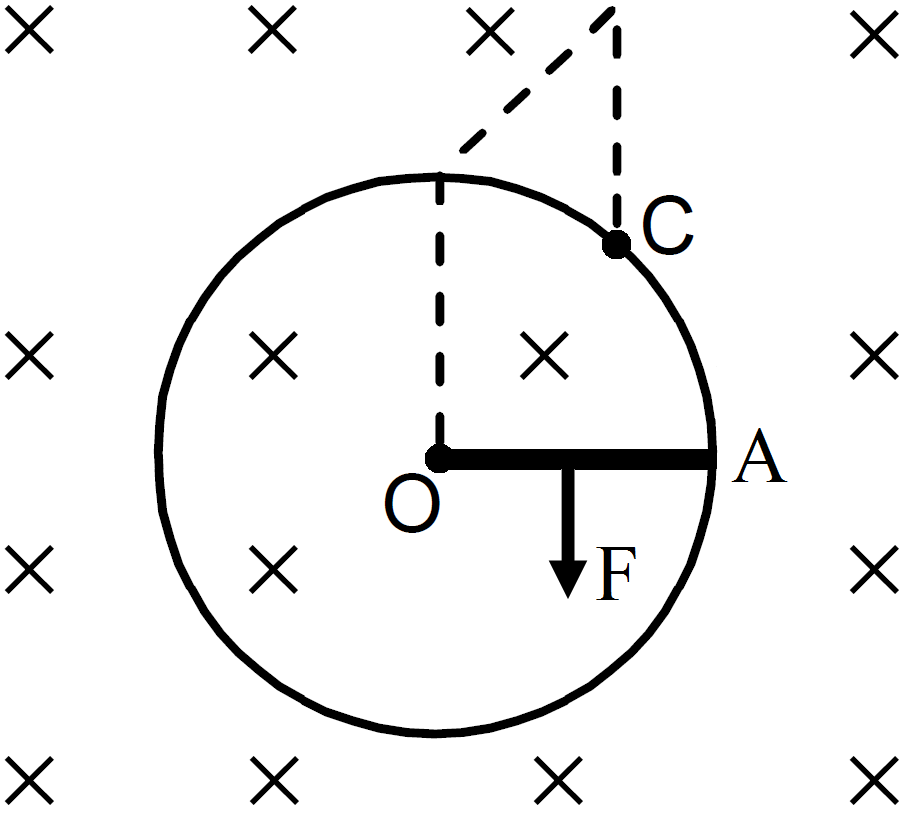
Figure shows a conducting circular loop of radius a placed in a uniform, perpendicular magnetic field B. A thick metal rod OA is pivoted at the centre O. The other end of the rod touches the loop at A. The centre O and a fixed point C on the loop are connected by a wire OC of resistance R. A force is applied at the middle point of the rod OA perpendicularly, so that the rod rotates clockwise at a uniform angular velocity $\omega.$ Find the force.
The height of mercury column in a barometer in a Calcutta laboratory was recorded to be 75 cm . Calculate this pressure in SI and CGS units using the following data: Specific gravity of mercury = 13.6, Density of water = $10^3 \mathrm{~kg} / \mathrm{m}^3, \mathrm{~g}=9.8 \mathrm{~m} / \mathrm{s}^2$ at Calcutta. Pressure $=\mathrm{h} \rho \mathrm{g}$ in usual symbols.
Prove that the maximum horizontal range is four times the maximum height attained by a projectile which is fired along the required oblique direction.
For a wire of a material radius 0.5 mm , Young's modulus of elasticity of the material of the wire $2 \times 10^{11} N / m ^2$ and if strain of the wire cannot be more than $10^{-3}$ then how much weight can be suspended from the wire?
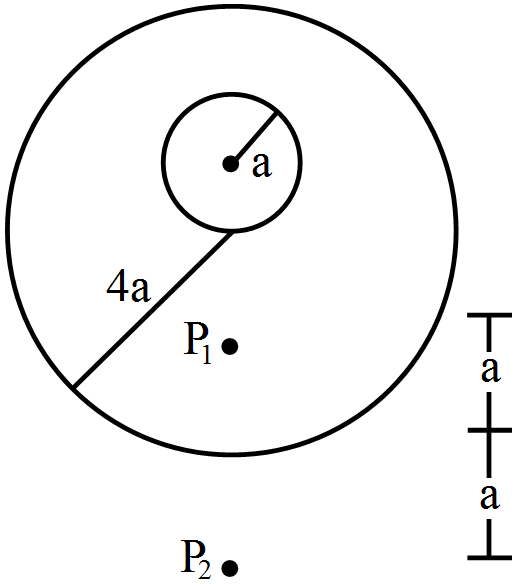
A uniform metal sphere of radius a and mass M is surrounded by a thin uniform spherical shell of equal mass and radius 4a The centre of the shell falls on the surface of the inner sphere. Find the gravitational field at the points $P_1$ and $P_2$ shown in the figure.
The refractive index of a material changes by 0.014 as the colour of the light changes from red to violet. A rectangular slab of height 2.00cm made of this material is placed on a newspaper. When viewed normally in yellow light, the letters appear 1.32cm below the top surface of the slab. Calculate the dispersive power of the material.