MCQ
Which heat is produced throughout the conducting wire?
  • A
    Petlier heat
  • B
    Thomson effect heat
  • C
    Joule heat
  • D
    none of these

Answer

  1. Joule heat

Explanation:

As the heat produced in the conductor by following Joule's law of heating or cooling. Sp, the produced heat is Joule heat.

Need a full question paper?

Generate a complete, print-ready paper with questions like this in minutes — across 16+ boards, with answer keys.
Start Generating Free

Similar questions

The neutralisation of a strong acid by a strong base liberates an amount of energy per mole of ${H^ + }$ that
At constant volume, $4\; mol$ of an ideal gas when heated from $300\; \mathrm{K}$ to $500\; \mathrm{K}$ changes its internal energy by $5000\; \mathrm{J}$. The molar heat capacity at constant volume is ............... $\mathrm{J\,mol}^{-1} \, \mathrm{K}^{-1}$
Among the following, the molecule with the lowest dipole moment is
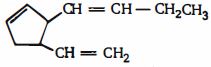
Total number of stereoisomers possible for following compound is
Look at the figure below and find the hybridisation of carbon atom.
Image
2-Bromopentane is heated with EtONa+ in ethanol. The major product obtained is:
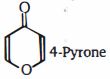
On reaction with acid, $4$ -pyrone gives a very stable cationic product. Which of the following structures shows the protonation site in- that product ?
The transformation occurring in Duma's method is given below :

$\mathrm{C}_{2} \mathrm{H}_{7} \mathrm{~N}+\left(2 \mathrm{x}+\frac{\mathrm{y}}{2}\right) \mathrm{CuO} \rightarrow \mathrm{x\,CO}_{2}+\frac{y}{2} \mathrm{H}_{2} \mathrm{O}+\frac{\mathrm{z}}{2} \mathrm{~N}_{2}+\left(2\, \mathrm{x}+\frac{\mathrm{y}}{2}\right) \mathrm{Cu}$

The value of $y$ is ...... .(Integer answer)

At a particular temperature and atmospheric pressure, the solid and liquid phases of a pure substance can exist in equilibrium. Which of the following term defines this temperature?
Assertion : $Pb^{4+}$ compounds are stronger oxidizing agents than $Sn^{4+}$ compounds.

Reason : The higher oxidation states for the group $14$ elements are more stable for the heavier members of the group due to ‘inert pair effect’.