Question
Which hormones are secreted by the posterior pituitary gland? What function does each serve? Where are these hormones actually produced? How are these hormones transported to the region from where they are released?

Answer

Oxytocin and vasopressin are secreted by the posterior pituitary gland.
  1. Oxytocin: is released into the blood when hypothalamic neurons are stimulated by the widening of uterus at the time of delivery or by the sucking of breasts by an infant. It induces contraction of smooth muscles of the uterus during the birth of a youngone and myoepithelial cells of mammary glands to cause release of milk during sucking by an infant. Therefore, it is also known as 'birth hormone'.
  2. Vasopressin: is also called Antidiuretic Hormone (ADH). It decreases the loss of water in urine by increasing reabsorption of water in distal convoluted tubules, collecting tubules and collecting ducts of kidneys.

Need a full question paper?

Generate a complete, print-ready paper with questions like this in minutes — across 16+ boards, with answer keys.
Start Generating Free

Similar questions

A gardener finds some broad-leaved dicot weeds growing in his lawns. What can be done to get rid of the weeds efficiently?
Write the features that distinguish between the two, Plasma and Serum.
How does water moves within the root?
Explain the structure of bacteriophage with the help of well-labelled diagram.
Describe the nervous system of cockroach.
Give a diagrammatic representation of ATP synthesis.
Ankit, a Xl class student was continuously listening to his sister and her friend's discussion about the growth of plant. They were discussing that plant growth involves three phenomena, i.e., differentiation, dedifferentiation and redifferention. Listening this Ankit interrupted them in between and asked her sister to elaborate the things in detail and the basic phenomenon behind it. As the topic was the part of the Ankit's syllabus also. Her sister explained him that the cells in plant undergo differentiation to attain a maturity in order to perform specific functions.
  1. What is dedifferentiation? Name two tissues formed by this process phenomenon.
  2. What is redifferentiation?
  3. What value is learnt from the Ankit's character as an ideal biology student.
Mango and coconut are ‘drupe’ type of fruits. In mango fleshy mesocarp is edible. What is the edible part of coconut? What does milk of tender coconut represent?
Many discoveries in science have been accidental. This is true for plant hormones also. Can you justify this statement by giving an example? Also what term is used for such accidental findings?
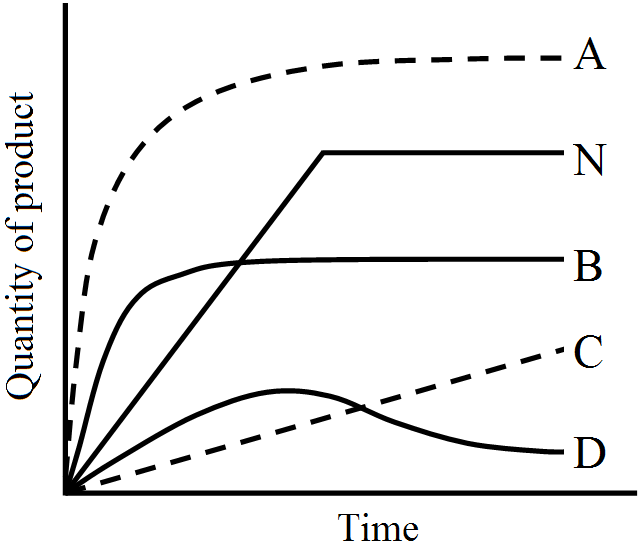
The lines A to D below show how change in temperature can affect the rate of enzyme reaction. Line N shows the rate of reaction under optimum temperature. Which line A, B, C or D shows the rate of enzyme reaction at 60°C?