Question
Which important property did Mendeleev use to classify the elements in his periodictable and did he stick to that?

Answer

Mendeleev organized the components in his periodic table, according to the order of their atomic weight. Mendeleev organized the components in groups and periods according to the increasing atomic weight. Mendeleev set the elements which are having comparative properties in the similar groups.
Nonetheless, he didn’t adhere to arrangement that he gave for long. He discovered that if the elements were organized according to their increasing atomic weights, then a few elements did not match within this plan of characterization.
In this manner, he overlooked the order of atomic weights now and again. For instance, the atomic mass of iodine is lower than atomic mass of tellurium.
Still Mendeleev set tellurium (in Group 6) ahead of iodine (in Group 7) essentially in light of the fact that iodine’s properties are so comparable to fluorine, chlorine, and bromine.
Need a full question paper?

Generate a complete, print-ready paper with questions like this in minutes — across 16+ boards, with answer keys.

Start Generating Free

Similar questions

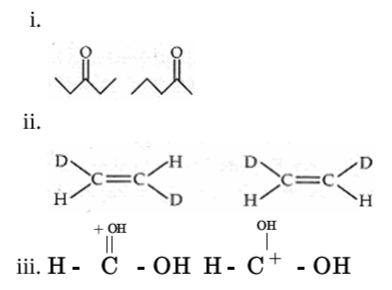
1. What is the relationship between the members of following pairs of structures? Are they structural or geometrical isomers or resonance contributors?
Image
2. A sample of 0.50 g of an organic compound was treated according to Kjeldahl's method. The ammonia evolved was absorbed in 50 mL of $0.5 M H _2 SO _4$. The residual acid required 60 mL of 0.5 M solution of NaOH for neutralisation. Find the percentage composition of nitrogen in the compound.
The reactant which is entirely consumed in reaction is known as limiting reagent. In the reaction 2A + 4B → 3C + 4D, when 5 moles of A react with 6 moles of B, then
  1. Which is the limiting reagent?
  2. Calculate the amount of C formed?
The ionization constant of nitrous acid is 4.5 × 10⁻⁴. Calculate the pH of 0.04M sodium nitrite solution and also its degree of hydrolysis.
Show that the degree of dissociation $(\alpha)$ for the dissociation of PCl5 into PCl3 $\alpha=\Big(\frac{\text{K}_{\text{p}}}{\text{p}+\text{K}_{\text{p}}}\Big)^{\frac{1}{2}}$ and Cl2 in pressure p is given by,
Which of the following are isoelectronic species i.e., those having the same number of electrons?
$\text{Na}^+,\text{K}^+,\text{Mg}^{2+},\text{Ca}^{2+},\text{S}^{2-},\text{Ar}.$
How many neutrons and protons are there in the following nuclei?
$\text{ }^{13}_{06}\text{C},\text{ }^{16}_{08}\text{O},\text{ }^{24}_{12}\text{Mg},\text{ }^{56}_{26}\text{Fe},\text{ }^{88}_{38}\text{Sr}$
What is conformational isomerism? Explain it with the help of ethane.
How will you write the structure of compound from the IUPAC name of it and from wrong name how will you write the correct name? Explain.
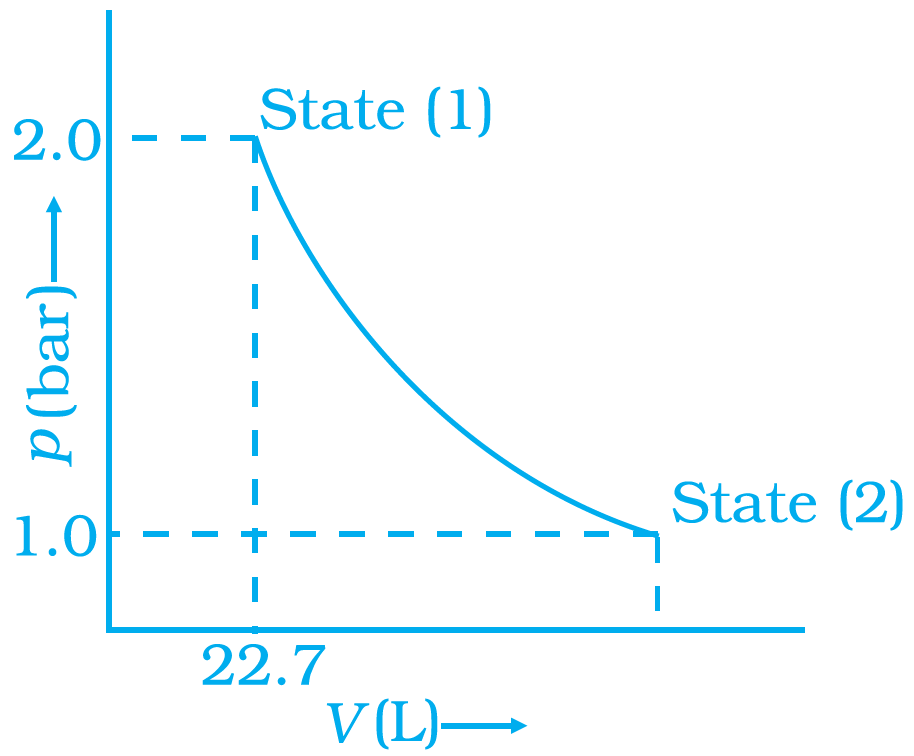
1.0 mol of a monoatomic ideal gas is expanded from state (1) to state (2) as shown in Fig. Calculate the work done for the expansion of gas from state (1) to state (2) at 298K.

Explain IUPAC system of nomenclature of elements with example.