MCQ
Which instrument is used as the null detector in the Wheatstone bridge?
- AVoltmeter
- BAmmeter
- CGalvanometer
- DMultimeter
Explanation:
A galvanometer is used as the null detector in a Wheatstone bridge. The null point means the situation in which no current flows through the circuit. The galvanometer is used for measuring the current and also to determine the voltage between any two points of the circuit. Galvanometer is used due to its sensitivity and therefore, even small currents can be measured.
Generate a complete, print-ready paper with questions like this in minutes — across 16+ boards, with answer keys.
Given a point source of light, which of the following can produce a parallel beam of light
|
(a) Convex mirror |
|
(b) Concave mirror |
|
(c) Concave lens |
|
(d) Two plane mirrors inclined at an angle of 90° |
The potential difference between point A & B is

|
(a) |
(b) |
(c) |
(d) 0 |
A long magnetic needle of length 2L, magnetic moment M and pole strength m units is broken into two pieces at the middle. The magnetic moment and pole strength of each piece will be
|
(a) |
(b) M, |
(c) |
(d) M, m |
Assertion : Ultraviolet radiation are of higher frequency waves are dangerous to human being.
Reason : Ultraviolet radiation are absorbed by the atmosphere
|
(a) If both assertion and reason are true and the reason is the correct explanation of the assertion. |
|
(b) If both assertion and reason are true but reason is not the correct explanation of the assertion. |
|
(c) If assertion is true but reason is false. |
|
(d) If the assertion and reason both are false. |
The smallest temperature difference that can be measured with a combination of a thermocouple of thermo e.m.f. 30mV per degree and a galvanometer of 50 ohm resistance, capable of measuring a minimum current of 3 × 10⁻⁷ amp is
|
(a) 0.5 degree |
(b) 1.0 degree |
(c) 1.5 degree |
(d) 2.0 degree |
V-i graphs for parallel and series combination of two identical resistors are as shown in figure. Which graph represents parallel combination
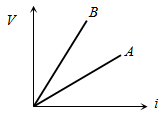
|
(a) A |
(b) B |
(c) A and B both |
(d) Neither A nor B |


