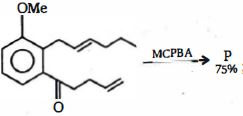
MCQ
Which is a buffer solution
  • $CH_3COOH + CH_3COONa$
  • B
    $CH_3COOH + CH_3COONH_4$
  • C
    $CH_3COOH + NH_4Cl$
  • D
    $NaOH + NaCl$

Answer

Correct option: A.
$CH_3COOH + CH_3COONa$
a
( $WA +$ salt of the $wA$ with $SB$ ) $=$ Acidic buffer

Need a full question paper?

Generate a complete, print-ready paper with questions like this in minutes — across 16+ boards, with answer keys.

Start Generating Free

Similar questions

In Bohr series of lines of hydrogen spectrum, the third line from the red end corresponds to which one of the following inter-orbit jumps of the electron for Bohr orbits in an atom of hydrogen
The reaction of calcium with water is represented by the equation $Ca + 2H_2O \to  Ca(OH)_2 + H_2$ What volume of $H_2$ at $STP$ would be liberated when $8\, gm$ of calcium completely reacts with water? .......... $\mathrm{cm}^{-3}$
Identify the element which can have highest oxidation numbers
Assertion : For an isothermal reversible process $Q = -W$ i.e. work done by the system equals the heat absorbed by the system. 
Reason : Enthalpy change $(\Delta H)$ is zero for isothermal process.
Equivalent amounts of $H_2$ and $I_2$ are heated in a closed vessel till equilibrium is obtained. If $80\%$ of the hydrogen is converted to $HI$, the $K_c$ at this temperature is
The addition of limited amount of water breaks the lump of lime. This process is called :
Newmann projection representation of. . . . ..  Then $X$ and $Y$ are respectively :

$\begin{array}{*{20}{c}} {{H_3}C - C{H_2} - CH - Et} \\ {\,\,\,\,\,\,\,\,\,\,\,\,\,\,\,\,\,\,\,\,\,\,\,\,\,\,\,\,\,\,\,\,\,\,\,|\,\,\,\,\,\,\,\,\,\,\,\,\,\,\,\,\,\,\,} \\ {\,\,\,\,\,\,\,\,\,\,\,\,\,\,\,\,\,\,\,\,\,\,\,\,\,\,\,\,\,\,\,\,\,\,\,\,C{H_3}\,\,\,\,\,\,\,\,\,\,\,\,\,\,\,} \end{array}$ about $C_2-C_3$ is (figure) 

When $KMn{O_4}$ acts as an oxidising agent and ultimately forms ${[\,Mn{O_4}]^{ - 2}},\,\,Mn{O_2},\,\,\,M{n_2}{O_3},\,\,M{n^{ + 2}}$ then the number of electrons transferred in each case respectively is
Which of the following is a buffer solution ?
Product $(P)$ is