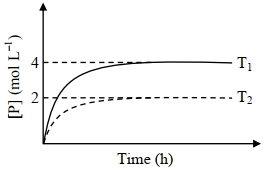
MCQ
Which is a Lewis base
- A${B_2}{H_6}$
- B$LiAl{H_4}$
- C$Al{H_3}$
- ✓$N{H_3}$
Generate a complete, print-ready paper with questions like this in minutes — across 16+ boards, with answer keys.
$O\left( g \right) + {e^ - } \to O_{\left( g \right)}^ - \,\,\,\,;\,\,\,\,{\Delta _f}{H^\Theta } = - 141\,kJ\,mo{l^{ - 1}}$
${O^ - }\left( g \right) + {e^ - } \to O_{\left( g \right)}^{2 - }\,\,\,\,;\,\,\,\,{\Delta _f}{H^\Theta } = + 780\,kJ\,mo{l^{ - 1}}$
Thus process of formation of $O_2^-$ in gas phase is unfavourable even thought $O_2^-$ is isoelectronic with neon. It is due to the fact that,
$(a)\,\,q + w$ $ (b)\,\,q$
$(c)\,\,w$ $ (d)\,\,H -TS$
$4N{H_3}(g)\,+\,5{O_2}(g)\,\, \rightleftharpoons \,4NO(g)\, + \,6{H_2}O(g)\, + \,Heat$
If $T_1=2 T_2$ and $\left(\Delta G_2^{\Theta}-\Delta G_1^{\varphi}\right)=R T_2 \ln x$, then the value of $x$ is. . . . .
$\left[\Delta G_1^\theta\right.$ and $\Delta G_2^\theta$ are standard Gibb's free energy change for the reaction at temperatures $T_1$ and $T_2$, respectively.]