MCQ
Which is a true statement concerning the transition state of an $S_{N^2}$ reaction ?
  • A
    Closely resembles a carbocation intermediate
  • B
    The electrophile is responsible for the reaction
  • C
    Lower is energy than the starting materials
  • Involves both the nucleophile and electrophile

Answer

Correct option: D.
Involves both the nucleophile and electrophile
d
$(d)$ For $S_{N^2}$ order $w.r.t.\, Nu$ is $1$ & order $w.r.t.$ substrate is one. if  reaction increases $10\, times$ when conc. of $(Nu)$ increases $10 \,times$.

Need a full question paper?

Generate a complete, print-ready paper with questions like this in minutes — across 16+ boards, with answer keys.

Start Generating Free

Similar questions

Iodoform is formed on warming ${I_2}$ and $NaOH$ with
The reaction,
Potassium permanganate on heating at $513\, \mathrm{~K}$ gives a product which is :
The unit of the velocity constant in case of zero order reaction is
Columns $1,2 and 3$ contain starting materials, reaction conditions, and type of reactions, respectively.

$column 1$ $column 2$ $column 3$
$(I)$ Toluene $(i)$ $\mathrm{NaOH} / \mathrm{Br}_2$ $(P)$ Condensation
$(II)$ Acetophenone $(ii)$ $\mathrm{Br}_2 / \mathrm{h} v$ $(Q)$ Carboxylation
$(III)$ Benzaldehyde $(iii)$ $\left(\mathrm{CH}_3 \mathrm{CO}\right)_2 \mathrm{O} / \mathrm{CH}_3 \mathrm{COOK}$ $(R)$ Substion
$(IV)$ Phenol $(iv)$ $\mathrm{NaOH} / \mathrm{CO}_2$ $(S)$ Haloform

($1$) For the synthesis of benzoic acid, the only $CORRECT$ combination is

$[A] (III) (iv) (R)$   $[B] (IV)(ii) (P)$   $[C] (I) (iv) (Q)$   $[D] (II) (i) (S)$

($2$)  The only CORRECT combination in which the reaction proceeds through radical mechanism is

$[A] (I)$ $(ii) (R)$     $[B] (II) (iii) (R)$     $[C] (III) (ii) (P)$    $[D] (IV) (i) (Q)$

($3$) The only CORRECT combination that gives two different carboxylic acids is

$[A] (IV) (iii) (Q)$ $[B] (III) (iii) (P)$ $[C] (II) (iv) (R)$ $[D] (I) (i) (S)$

Given the answer quetion ($1$) ($2$) and ($3$)
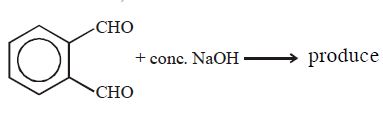
Product is :
$(A)$ on heating isomerizes to $(B)$ What is the structure of $(B)$ ?
Titanium oxide is added in interior paints for walls of rooms, halls and galleries to give:
In which of the following complex $C-O$ bond as maximum $IR$ stretching vibrational frequency :-