MCQ
Which is correct $?$

$\begin{array}{*{20}{c}}
  O \\ 
  {||} \\ 
  {C{H_3} - C{H_2} - C - C{H_2} - C{H_2}} 
\end{array}$

$\begin{array}{*{20}{c}}
  {\,\,\,\,\,\,\,\,\,\,\,\,\,\,\,\,\,\,\,\,\,\,\,\,\,\,\,\,\,\,\,\,\,\,\,\,\,\,\,\,O} \\ 
  {\,\,\,\,\,\,\,\,\,\,\,\,\,\,\,\,\,\,\,\,\,\,\,\,\,\,\,\,\,\,\,\,\,\,\,\,\,\,\,||} \\ 
  {C{H_3} - C{H_2} - C{H_2} - C - N{H_2}} 
\end{array}$

  • A
    Chain isomerism
  • B
    Positional isomerism
  • C
    Metamerism
  • Functional group isomerism

Answer

Correct option: D.
Functional group isomerism
d

Need a full question paper?

Generate a complete, print-ready paper with questions like this in minutes — across 16+ boards, with answer keys.

Start Generating Free

Similar questions

At $ 298 \,K$ , the solubility of $PbC{l_2}$ is $2 \times {10^{ - 2}}\,mol/lit$, then ${k_{sp}} = $
The $\text{F}-\text{B}-\text{F}$ bond angle in $\ce{BF_3}$ molecule is :
Mixture of ice and water is form a :
The compound($s$) which react($s$) with $NH _3$ to give boron nitride ($BN$) is(are)

$(A)$ $B$ $(B)$ $B _2 H _6$ $(C)$ $B _2 O _3$ $(D)$ $HBF _4$

One mole of $PCl_5$ is heated in a closed container of one litre capacity. At equilibrium, $20\%$ $PCl_5$ is not dissociated. What should be the value of $K_C$ ?
Assertion : Spin quantum number can have two values, $+\frac{1}{2}$ and $-\frac{1}{2}$ .
Reason : $+$ and $-$ signs signify the positive and negative wave functions.
Prussian blue is formed when
Which branch of chemistry is a cost effective approach which involves reduction in material, energy consumption and waste generation?
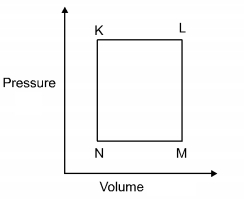
A fixed mass ' $m$ ' of a gas is subjected to transormation of states from $K$ to $L$ to $M$ to $N$ and back to $K$ as shown$Image$

$1.$ The succeeding operations that enable this transformation of states are

$(A)$ Heating, cooling, heating, cooling

$(B)$ Cooling, heating, cooling, heating

$(C)$ Heating, cooling, cooling, heating

$(D)$ Cooling, heating, heating, cooling

$2.$ The pair of isochoric processes among the transormation of states is

$(A)$ $K$ to $L$ and $L$ to $M$

$(B)$ $L$ to $M$ and $N$ to $K$

$(C)$ $L$ to $M$ and $M$ to $N$

$(D)$ $M$ to $N$ and $N$ to $K$

Give the answer question $1$ and $2.$

Which species has the same shape as $NH_3$ ?