MCQ
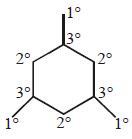
Which is correctly matched
- A(figure) - Heterocyclic compound

- B(figure) - only two types of carbon and hydrogen present

- C(figure) - Homocyclic compound

- ✓(figure) - Equal number of $1^o, 2^o$ and $3^o$

Generate a complete, print-ready paper with questions like this in minutes — across 16+ boards, with answer keys.
$2 \mathrm{~A}_{(\mathrm{g})}+\mathrm{B}_{(\mathrm{g})} \rightarrow \mathrm{C}_{(\mathrm{g})}$
The initial rate of the reaction is recorded as $r_1$ when the reaction starts with $1.5 \mathrm{~atm}$ pressure of $\mathrm{A}$ and $0.7 \mathrm{~atm}$ pressure of B. After some time, the rate $r_2$ is recorded when the pressure of $C$ becomes $0.5 \mathrm{~atm}$. The ratio $r_1: r_2$ is $\qquad$ $\times 10^{-1}$.
(Nearest integer)
$(i)\,\,(CH_3)_2CH - CH_2Br \xrightarrow{{{C_2}{H_5}OH}}$ $ (CH_3)_2CH - CH_2OC_2H_5 + HBr$
$(ii)\,\,(CH_3)_2CH - CH_2Br \xrightarrow{{{C_2}{H_5}O^-}} $ $(CH_3)_2CH - CH_2OC_2H_5 + Br^-$
The mechanisms of reactions $(i)$ and $(ii)$ are respectively