MCQ
Which is correctly matched
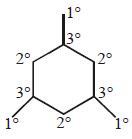
- A(figure) - Heterocyclic compound

- B(figure) - only two types of carbon and hydrogen present

- C(figure) - Homocyclic compound

- ✓(figure) - Equal number of $1^o, 2^o$ and $3^o$

Generate a complete, print-ready paper with questions like this in minutes — across 16+ boards, with answer keys.
On addition of equal number of moles of a non-volatile solute $S$ in equal amount (in $kg$ ) of these solvents, the elevation of boiling point of solvent $X$ is three times that of solvent $Y$. Solute $S$ is known to undergo dimerization in these solvents. If the degree of dimerization is $0.7$ in solvent $Y$, the degree of dimerization in solvent $X$ is. . . . . . .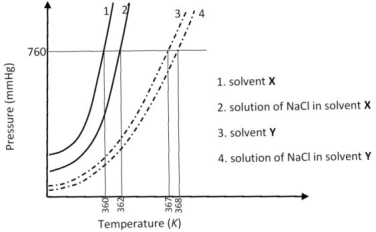
$n - Bu -\equiv\frac{(i) n-BuLi,n - C _{5} H _{11} Cl}{(ii) Lindlar\,\, cat, H _{2}}$

$A \,|\, A^+\, (xM)\, ||\, B^+ \,(yM)\, |\, B$
The $emf$ measured is $+ 0.20\, V.$ The cell reaction is
| List-$I$ (Molecule) | List-$II$(Shape) |
| $A$ $\mathrm{NH}_3$ | $I$ Square pyramid |
| $B$ $\mathrm{BrF}_5$ | $II$ Tetrahedral |
| $C$ $\mathrm{PCl}_5$ | $III$ Trigonal pyramidal |
| $D$ $\mathrm{CH}_4$ | $IV$ Trigonal bipyramidal |
Choose the correct answer from the option below :