Question
Which is easier to remove: orbital electron from an atom or a nucleon from a nucleus?

Answer

It is easier to remove an orbital electron from an atom. The reason is the binding energy of orbital electron is a few electron-volts while that of nucleon in a nucleus is quite large (nearly 8MeV). This means that the removal of an orbital electron requires few electron volt energy while the removal of a nucleon from a nucleus requires nearly 8MeV energy.

Need a full question paper?

Generate a complete, print-ready paper with questions like this in minutes — across 16+ boards, with answer keys.
Start Generating Free

Similar questions

A converging lens and a diverging mirror are placed at a separation of 15cm. The focal length of the lens is 25cm and that of the mirror is 40cm. Where should a point source be placed between the lens and the mirror so that the light, after getting reflected by the mirror and then getting transmitted by the lens, comes out parallel to the principal axis?
Explain Electric Flux.
The normal activity of living carbon-containing matter is found to be about 15 decays per minute for every gram of carbon. This activity arises from the small proportion of radioactive $ ^{14}_6\text{C}$ present with the stable carbon isotope $^{12}_6\text{C}.$ When the organism is dead, its interaction with the atmosphere (which maintains the above equilibrium activity) ceases and its activity begins to drop. From the known half-life (5730 years) of $^{14}_6\text{C },$ and the measured activity, the age of the specimen can be approximately estimated. This is the principle of  $^{14}_6\text{C}$ datingused in archaeology. Suppose a specimen from Mohenjodaro gives an activity of 9 decays per minute per gram of carbon. Estimate the approximate age of the Indus-Valley civilisation.
A short bar magnet has a magnetic moment of $0.48 JT ^{-1}$.Give the direction and magnitude of the magnetic field produced by the magnet at a distance of 10 cm from the centre of the magnet on (a) the axis, (b) the equatorial lines (normal bisector) of the magnet.
A 12.3 eV electron beam is used to bombard gaseous hydrogen at room temperature. Upto which energy level the hydrogen atoms would be excited?
Calculate the wavelengths of the second member of Lyman series and second member of Balmer series.
An electric bulb is designed to operate at 12 volts DC. If this bulb is connected to an AC source and gives normal brightness, what would be the peak voltage of the source?
A regular hexagon of side 10 cm has a charge 5 µC at each of its vertices. Calculate the potential at the centre of the hexagon.
What potential difference should be applied across an X-ray tube to get X-ray of wavelength not less than 0.10nm? What is the maximum energy of a photon of this X-ray in joule?
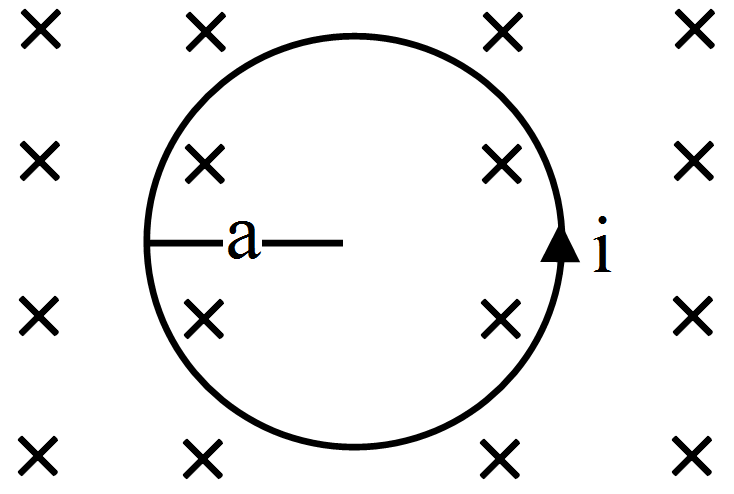
The shows a circular wire loop of radius a and carrying a current i, which is placed in a perpendicular magnetic field B.
  1. Consider a small part dl of the wire. Find the force on this part of the wire exerted by the magnetic field.
  2. Find the force of compression in the wire.

An ideal diode should pass a current freely in one direction and should stop it completely in the opposite direction. Which is closer to ideal-vacuum diode or a p-n junction diode?