MCQ
Which is heaviest
  • A
    $25\,gm$ of mercury
  • B
    $2 \,moles$ of water
  • $2\,moles$ of carbon dioxide
  • D
    $4\,gm$ atoms of oxygen

Answer

Correct option: C.
$2\,moles$ of carbon dioxide
c
Mass of $1\, mole$ of carbon dioxide $=44 \,g$

So, the mass of $2 \,moles$ of carbon dioxide $=88\, g$

Hence, $2\, moles$ of carbon dioxide is heaviest and the correct option is $C$.

Need a full question paper?

Generate a complete, print-ready paper with questions like this in minutes — across 16+ boards, with answer keys.

Start Generating Free

Similar questions

Standard reduction frotential of $\text{X, Y, Z}$ are ${-1.2v, +0.5v, -3.0v}$ respectively, the reducing power of the metals will be :
Which of the following processes takes place with decrease of entropy?
Which of the following molecules has the maximum dipole moment ?
The liquefaction behaviour of the temporary gases like $\ce{CO_2}$ approaches that of permanent gases like $\ce{N_2 , O_2}$ etc., as we go :
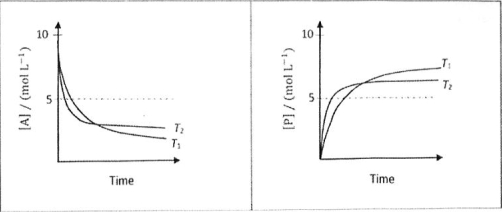
For a reaction, $A \rightleftharpoons P$, the plots of $[ A ]$ and $[ P ]$ with time at temperatures $T _1$ and $T _2$ are given below.

If $T _2> T _1$, the correct statement(s) is (are)

(Assume $\Delta H ^{\ominus}$ and $\Delta S ^{\ominus}$ are independent of temperature and ratio of $\ln K$ at $T _1$ to $\ln K$ at $T_2$ is greater than $T_2 / T_1$. Here $H, S, G$ and $K$ are enthalpy, entropy, Gibbs energy and equillibrium constant, respectively.)

$(A)$ $\Delta H ^{\ominus}<0, \Delta S ^{\ominus}<0$  $(B)$ $\Delta G ^{\ominus}<0, \Delta H ^{\ominus}>0$  $(C)$ $\Delta G ^{\ominus}<0, \Delta S ^{\ominus}<0$  $(D)$ $\Delta G ^{\ominus}<0, \Delta S ^{\ominus}>0$

In the reaction $SnCl_2(excess)+HgCl_2\ \rightarrow\ A+SnCl_4$, '$A$' is
$2.1 \,g $ of $ Fe$  combines with $S$  evolving $ 3.77 \,kJ$. The heat of formation of $FeS$ in $kJ/mol $ is
On passing a current of $HCl$ gas in a saturated solution of $NaCl,$ the solubility of $NaCl$
Taking into account the stability of various carbocations and, as well as the rules  governing mechanisms of carbocation rearrangements, which reaction is most  likely to occur during the given reaction ?
Which of the following molecule has highest bond energy