MCQ
Which is incorrect about Hunsdicker reaction ?
- ✓Only $Cl_2$ can give alkyl halide
- B$I_2$ will give ester when treated with $RCOOAg$
- CThe reaction proceeds through free radical
- D$F_2$ cannot give alkyl halide
Generate a complete, print-ready paper with questions like this in minutes — across 16+ boards, with answer keys.
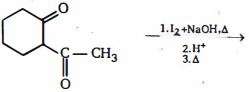
$\mathrm{HX}(\mathrm{aq}) \rightleftharpoons \mathrm{H}^{+}(\mathrm{aq})+\mathrm{X}(\mathrm{aq}), \mathrm{Ka}=1.2 \times 10^{-5}$
$\left[\mathrm{K}_{\mathrm{n}}:\right.$ dissociation constant]
The osmotic pressure of $0.03 \mathrm{M}$ aqueous solution of $\mathrm{HX}$ at $300 \mathrm{~K}$ is ............... $\times 10^{-2}$ bar (nearest integer).
$\left[\right.$ Given : $\mathrm{R}=0.083 \mathrm{~L} \mathrm{bar} \mathrm{Mol}^{-1} \mathrm{~K}^{-1}$ ]
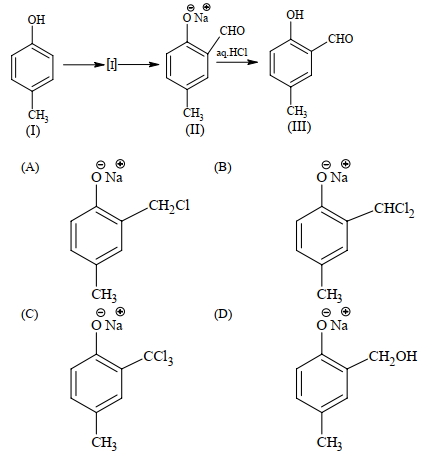
$Image$
$1.$ Which one of the following reagents is used in the above reaction?
$(A)$ aq. $\mathrm{NaOH}+\mathrm{CH}_3 \mathrm{Cl}$
$(B)$ aq. $\mathrm{NaOH}+\mathrm{CH}_2 \mathrm{Cl}_2$
$(C)$ aq. $\mathrm{NaOH}+\mathrm{CHCl}_3$
$(D)$ aq. $\mathrm{NaOH}+\mathrm{CCl}_4$
$2.$ The electrophile in this reaction is
$(A)$ : $\mathrm{CHCl}$ $(B)$ ${ }^{+} \mathrm{CHCl}_2$
$(C)$ $\mathrm{CCl}_2$ $(D)$. $\mathrm{CCl}_3$
$3.$ The structure of the intermediate $I$ is
$Image$
Give the answer question $1, 2$ and $3.$