MCQ
Which is not a unit of electric field
  • A
    $N{C^{ - 1}}$
  • B
    $V{m^{ - 1}}$
  • $J{C^{ - 1}}$
  • D
    $J{C^{ - 1}}{m^{ - 1}}$

Answer

Correct option: C.
$J{C^{ - 1}}$
c
$SI$ unit of electric field strength is newtons per coulomb $( N / C )$ or volts per meter $( V / m )$.

It is also expressed as $JC ^{-1} m ^{-1}$.

Need a full question paper?

Generate a complete, print-ready paper with questions like this in minutes — across 16+ boards, with answer keys.
Start Generating Free

Similar questions

The velocity of sound in a gas. in which two wavelengths $4.08\,m$ and $4.16\,m$ produce $40$ beats in $12\,s$, will be ..............$ms ^{-1}$
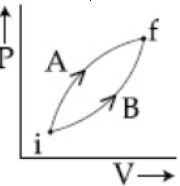
Following figure shows two processes $A$ and $B$ for a gas. If $\Delta Q_A$ and $\Delta Q_B$ are the amount of heat absorbed by the system in two cases, and $\Delta U_A$ and $\Delta U_B$ are changes in internal energies, respectively, then
The translational degrees of freedom $(f)$ and rotational degrees of freedom $(f)$ of $\mathrm{CH}_4$ molecule are:
Let the angle between two nonzero vectors $\overrightarrow A $ and $\overrightarrow B $ be $120^°$ and resultant be $\overrightarrow C $
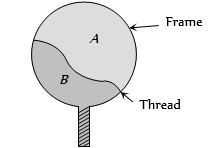
A thread is tied slightly loose to a wire frame as in figure and the frame is dipped into a soap solution and taken out. The frame is completely covered with the film. When the portion $A$ punctured with a pin, the thread.
The centre of mass of an extended body on the surface of the earth and its centre of gravity.
A light rod of length $200\,cm$ is suspended from the ceiling horizontally by means of two vertical wires of equal length tied to its ends. One of the wires is made of steel and is of cross-section $0.1\,cm^2$ and the other of brass of cross-section $0.2\,cm^2$ . Along the rod at which distance a weight may be hung to produce equal stresses in both the wires?
A body of mass ' ${m}$ ' dropped from a height ' ${h}$ ' reaches the ground with a speed of $0.8 \sqrt{{gh}}$. The value of workdone by the air-friction is $.....\,{mgh}$
Two particle executing $S.H.M.$ of same amplitude of $20 \,cm$ with same period along the same line about same equilibrium position. The maximum distance between the two is $20 \,cm$. Their phase difference in radian is equal to
A disc is rolling without slipping on a surface. The radius of the disc is $R$. At $t=0$, the top most point on the disc is $A$ as shown in figure. When the disc completes half of its rotation, the displacement of point $A$ from its initial position is