MCQ
Which is not an electrophile among the following
  • A
    $AlCl_3$
  • B
    $\mathop N\limits^ \oplus  {O_2}$
  • C
    $BF_3$
  • D
    ${H_3}{O^ \oplus }$

Answer

Electron deficient species are known as electrophiles.

Among the given, $H_{3} O$ has lone pair of electrons for donation, so it is not electron deficient and hence, not an electrophile.

Need a full question paper?

Generate a complete, print-ready paper with questions like this in minutes — across 16+ boards, with answer keys.

Start Generating Free

Similar questions

A solution of weak acid $HA$ containing $0.01$ moles of acid per litre of solutions has $pH = 4$. The percentage degree of ionisation of the acid and the ionisation constant of acid are respectively.
The value of the ion product constant for water, $(K_w )$ at $60\,^oC$ is $9.6 \times 10^{-14} \,M^2$. What is the $[H_3O^+]$ of a neutral aqueous solution at $60\,^oC$ and an  aqueous solution with a $pH = 7.0$ at $60\,^oC$ are respectively ?
$\begin{matrix}
   O\,\,\,\,\,\,\,\,\,\,\,\,\,\,\,\,\,\,\,\,\,\,\,  \\
   ||\,\,\,\,\,\,\,\,\,\,\,\,\,\,\,\,\,\,\,\,\,\,\,\,  \\
   N{{H}_{2}}-CH-C-NH-C{{H}_{2}}-C{{O}_{2}}H  \\
   |\,\,\,\,\,\,\,\,\,\,\,\,\,\,\,\,\,\,\,\,\,\,\,\,\,\,\,\,\,\,\,\,\,\,\,\,\,\,\,\,\,\,\,\,\,\,\,\,\,\,\,\,\,\,\,\,\,\,\,\,  \\
   C{{H}_{3}}\,\,\,\,\,\,\,\,\,\,\,\,\,\,\,\,\,\,\,\,\,\,\,\,\,\,\,\,\,\,\,\,\,\,\,\,\,\,\,\,\,\,\,\,\,\,\,\,\,\,\,\,\,\,  \\
\end{matrix}$

Identify the amino acid obtained by hydrolysis of the above compound
$0.1$ $mole$ of $CH_3NH_2 (K_b = $ $5 \times 10^{-4} $ $)$ is mixed with $0.08 $ $mole$ of $ HCl $ and diluted to one litre. What will be the $H^+ $ concentration in the solution?
Which of the following compounds $+ve$ charge is not show resonance ?
What is entropy of vaporisation of water at $100\,^oC$ , If molar heat of vaporisation is $9710\,cal/mol$ .........$cal/K/mol$
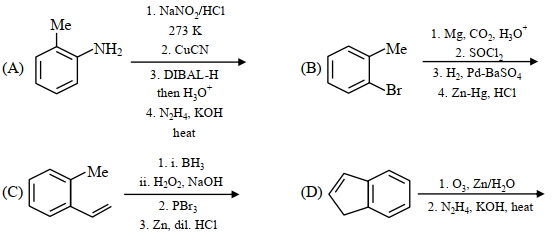
The reaction sequence($s$) that would lead to $o$-xylene as the major product is (are)
Benzene is the polymer of
The compound which forms a dative bond with ammonia
$K_1, K_2$ and $K_3$ are the equilibrium constants of the following reactions $(I), (II)$ and $(III)$, respectively :-
$(I)$ $N_2 + 2O_2  \rightleftharpoons  2NO_2$
$(II)$ $2NO_2  \rightleftharpoons  N_2 + 2O_2$
$(III)$ $NO_2  \rightleftharpoons  \frac{1}{2}N_2 + O_2$
The correct relation from the following is