MCQ
Which is not an electrostatic phenomenon:
  • A
    Comb rubbed with hair attracts paper bits.
  • B
    A blanket in winters in dark when scrambled gives electrical sparks.
  • C
    Two people shaking hands feel a small spark in winters.
  • D
    Heat is generated in a resistor carrying current.
Answer

  1. Heat is generated in a resistor carrying current.

Explanation:


(d) is based on Joule's Law.

Rest are electrostatic phenomenon.

Need a full question paper?

Generate a complete, print-ready paper with questions like this in minutes — across 16+ boards, with answer keys.

Start Generating Free

Similar questions

In the circuit shown here, at which point is the current least?

In Young’s experiment, monochromatic light is used to illuminate the two slits A and B. Interference fringes are observed on a screen placed in front of the slits. Now if a thin glass plate is placed normally in the path of the beam coming from the slit


(a) The fringes will disappear

(b) The fringe width will increase

(c) The fringe width will increase

(d) There will be no change in the fringe width but the pattern shifts

Pick out the application of potentiometer from the following.

Resistance of tungsten wire at 150  is 133 . Its resistance temperature coefficient is 0.0045/. The resistance of this wire at 500  will be

(a) 180 Ω

(b) 225 Ω

(c) 258 Ω

(d) 317 Ω

A boy of mass M is applying a horizontal force to slide a box of mass M' on a rough horizontal surface. The coefficient of friction between the shoes of the box and the floor is $\mu.$ In which of the following cases it is certainly not possible to slide the box?

  1. $\mu<\mu',\text{M < M}'$

  2. $\mu>\mu',\text{M < M}'$

  3. $\mu<\mu',\text{M > M}'$

  4. $\mu>\mu',\text{M > M}'$

A semi-circular arc of radius 'a' is charged uniformly and the charge per unit lengths is $\lambda$. The electric field at the centre is:
Huygens' principle of secondary wavelets may be used to:
  1. Find the velocity of light in vacuum.
  2. Explain the particle behaviour of light.
  3. Find the new position of a wavefront.
  4. Explain Snell's law.

If in the circuit shown below, the internal resistance of the battery is 1.5 W and VP and VQ are the potentials at P and Q respectively, what is the potential difference between the points P and Q

(a)  Zero 

(b) 4 volts (VP > VQ)

(c) 4 volts (VQ > VP)

(d) 2.5 volts (VQ > VP)

Equivalent resistance between the points A and B is (in W)

(a)   

(b) 1 

(c) 2 

(d) 3 

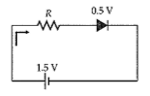
The diode used in the circuit shown in the figure has a constant voltage drop at 0.5 V at all currents and a maximum power rating of 100 milliwatts. What should be the value of the resistor R, connected in series with diode for obtaining maximum current?
Image