MCQ
Which is the best synthesis of .........?
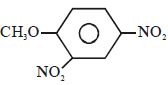
  • (image) $\xrightarrow[FeB{{r}_{3}}]{B{{r}_{2}}}\,\,\,\xrightarrow[{{H}_{2}}S{{O}_{4}}]{HN{{O}_{3}}}$  $\xrightarrow[{{H}_{2}}S{{O}_{4}}]{HN{{O}_{3}}}\,\,\xrightarrow[C{{H}_{3}}OH]{NaOC{{H}_{3}}}$
  • B
    (image) $ \xrightarrow[{{H_2}S{O_4}}]{{HN{O_3}}}\,\,\xrightarrow[{{H_2}S{O_4}}]{{HN{O_3}}} $ $\xrightarrow[{FeB{r_3}}]{{B{r_2}}}\,\,\xrightarrow[{C{H_3}OH}]{{NaOC{H_3}}}$
  • C
    (image) $\xrightarrow[{{H_2}S{O_4}}]{{HN{O_3}}}\,\,\xrightarrow[{FeB{r_3}}]{{B{r_2}}} $ $\xrightarrow[{{H_2}S{O_4}}]{{HN{O_3}}}\,\,\xrightarrow[{C{H_3}OH}]{{NaOC{H_3}}}$
  • D
    (image) $ \xrightarrow[{{H_2}S{O_4}}]{{HN{O_3}}}\,\,\xrightarrow[{FeB{r_3}}]{{B{r_2}}}$ $\xrightarrow[{C{H_3}OH}]{{NaOC{H_3}}}\,\,\xrightarrow[{{H_2}S{O_4}}]{{HN{O_3}}}$
Answer

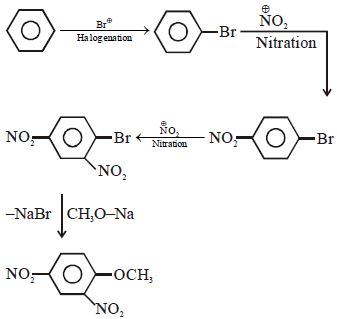
Correct option: A.
(image) $\xrightarrow[FeB{{r}_{3}}]{B{{r}_{2}}}\,\,\,\xrightarrow[{{H}_{2}}S{{O}_{4}}]{HN{{O}_{3}}}$  $\xrightarrow[{{H}_{2}}S{{O}_{4}}]{HN{{O}_{3}}}\,\,\xrightarrow[C{{H}_{3}}OH]{NaOC{{H}_{3}}}$
a

Need a full question paper?

Generate a complete, print-ready paper with questions like this in minutes — across 16+ boards, with answer keys.

Start Generating Free

Similar questions

$4 \mathrm{~g}$ equimolar mixture of $\mathrm{NaOH}$ and $\mathrm{Na}_{2} \mathrm{CO}_{3}$ contains $\mathrm{x} \mathrm{g}$ of $\mathrm{NaOH}$ and $\mathrm{y} \mathrm{g}$ of $\mathrm{Na}_{2} \mathrm{CO}_{3}$. The value of $x$ is $.....g.$ (Nearest integer)
If 22 gm of benzene $\left( C _6 H _6\right)$ is dissolved in 122 gm of carbon tetrachloride $\left( CCl _4\right)$ calculate the mass percentage of benzene.
For saturated solution of $CaF_2$, choose the correct relationship-
Which of the following compound does not react with cold and dil. $HNO_3$ ?
Which of the following compound gives $2HCHO,\, CO_2 ,\, HCO_2 H$ when  oxidised by periodic acid?
At $298 K$, the limiting molar conductivity of a weak monobasic acid is $4 \times 10^2 S cm ^2 mol ^{-1}$. At $298 K$, for an aqueous solution of the acid the degree of dissociation of $\alpha$ and the molar conductivity is $y \times 10^2 S cm ^2 mol ^{-1}$. At $298 K$, upon $20$ times dilution with water, the molar conductivity of the solution becomes $3 y \times 10^2 S cm ^2 mol ^{-1}$.

($1$) The value of $\alpha$ is. . . . . . 

($2$) The value of $y$ is. . . . . . .

Give the answer or quetion ($1$) and ($2$)

Total vapour pressure of mixture of  $1\,\,mol\,$ $\,X(P_x^o\,=\,150\,torr)$  and $2\,\,mol \,Y(P_y^o\,=\,300\,torr)$  is $240\,\,torr.$  In this case
The molar freezing point constant for water is ${1.86\,^o}C\,mol{e^{ - 1}}$. If $ 342\,gm$ of canesugar $({C_{12}}{H_{22}}{O_{11}})$ are dissolved in $1000\,gm$ of water, the solution will freeze at ............ $^oC$.
The oxidation state of $Mo$ in its oxo-complex species $[Mo_2O_4(H_2O)_2(C_2H_4)_2]^{2-}$ is :
$(i)$ $F _{3} C - COOH$

$(ii)$ $CH _{3} COOH$

$(iii) $ $C _{6} H _{5} COOH$

$(iv)$ $CH _{3} CH _{2} COOH$

Correct order of $pK _{ a }$ value is :