MCQ
Which is the $CORRECT$ relation of bond angles?
  • A
    $NH_3 > (CH_3)_3N > (SiH_3)_3N$
  • $(SiH_3)_3N > (CH_3)_3N > NH_3$
  • C
    $NH_3 > (SiH_3)_3N > (CH_3)_3N$
  • D
    $(CH_3)_3N > (SiH_3)_3N > NH_3$

Answer

Correct option: B.
$(SiH_3)_3N > (CH_3)_3N > NH_3$
b
$\mathrm{NH}_{3} \quad \mathrm{sp}^{3}: 107^{o}$

$\left(\mathrm{CH}_{3}\right)_{3} \mathrm{N} \quad \mathrm{sp}^{3}: 108^{o}$ -bulky have more

repulsion than smaller $H$

$-\left(\mathrm{SiH}_{3}\right)_{3} \mathrm{N} \cdot \mathrm{sp}^{2}: 120^{o}\, \mathrm{LP}$ of $\mathrm{N}$ engages in back

bonding with empty $d$ orbitals of $Si$

Need a full question paper?

Generate a complete, print-ready paper with questions like this in minutes — across 16+ boards, with answer keys.
Start Generating Free

Similar questions

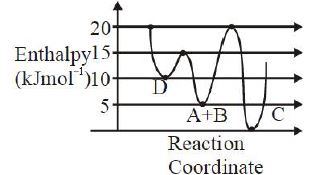
Consider the given plot of enthalpy of the following reaction between $A$ and $B$.
$A + B \to C + D$ Identify the incorrect statement
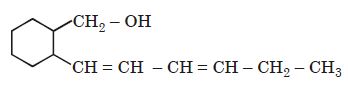
Total number of stereo-isomers possible for the following compound is
For a chemical reaction, $A + 2B \to C + D$, the rate of reaction increases three times, when concentration of $A$ only is increased nine times. While when concentration of $B$ only is increased $2\, times$, then rate of reaction also increases $2\, times$. The order of this reaction is
An ' Assertion' and a 'Reason' are given below. Choose the correct answer from the following options.

Assertion $(A)$ : Vinyl halides do not undergo nucleophilic substitution easily.

Reason $(R)$ : Even though the intermediate carbocation is stabilized by loosely held $p-$ electrons, the cleavage is difficult because of strong bonding.
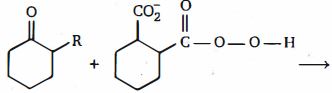
Above reaction is a Baeyer Villiger rearrangement of an asymmetric ketone with  magnesium mono peroxo pthalate hexahydrate (in the drawing, $Mg^{+2}$ is  omitted for clearity) Identify major product.
The solubility product of $Ag_2CO_3$ and $FeCO_3$ in water at $25\,^oC$ are $4 \times 10^{-12}$ and $2.5 \times 10^{-11}$ respectively. If $S_1$ and $S_2$ are their solubilities in water respectively when dissolved separately, then $S_1/S_2$ is
A solution which is resistant to change of $pH$ upon the addition of an acid or a base is known as
The neutralisation of a strong acid by a strong base liberates an amount of energy per mole of ${H^ + }$ that
The functional group that shows negative resonance effect is:
The oxide without nitrogen-nitrogen bond is :