MCQ
Which is the correct statement
  • For an isothermal change $P V=$ constant
  • B
    In an isothermal process the change in internal energy must be equal to the work done
  • C
    For an adiabatic change $\frac{P_2}{P_1}=\left(\frac{V_2}{V_1}\right)^\gamma$, where $\gamma$ is the ratio of specific heats
  • D
    In an adiabatic process work done must be equal to the heat entering the system
Answer

Correct option: A.
For an isothermal change $P V=$ constant
(a) Since $P V=R T$ and $T=$ constant; $\therefore P V=$ constant.

Need a full question paper?

Generate a complete, print-ready paper with questions like this in minutes — across 16+ boards, with answer keys.

Start Generating Free

Similar questions

Two particles each of mass $m$ and charge $q$ are attached to the two ends of a light rigid rod of length $2R$. The rod is rotated at constant angular speed about a perpendicular axis passing through its centre. The ratio of the magnitudes of the magnetic moment of the system and its angular momentum about the centre of the rod is
A transverse sinusoidal wave of amplitude $a$, wavelength $\lambda$ and frequency $n$ is travelling on a stretched string. The maximum speed of any point on the string is $v / 10$, where $v$ is the speed of propagation of the wave. If $a=10^{-3} \mathrm{~m}$ and $v=10 \mathrm{~ms}^{-1}$, then $\lambda$ and $n$ are given by
If force $(F)$, length $(L)$ and time $(T)$ are assumed to be fundamental units, then the dimensional formula of the mass will be
Two metallic spheres $S_1$ and $S_2$ are made of the same material and have identical surface finish. The mass of $S_1$ is three times that of $S_2$. Both the spheres are heated to the same high temperature and placed in the same room having lower temperature but are thermally insulated from each other. The ratio of the initial rate of cooling of $S_1$ to that of $S_2$ is
If a simple harmonic oscillator has got a displacement of $0.02\ m$ and acceleration equal to $ms ^{-}$at any time, the angular frequency of the oscillator is equal to
The minimum energy required to remove an electron is called
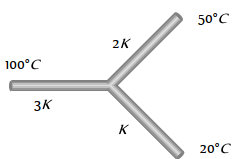
Three rods of the same dimension have thermal conductivities $3 K, 2 K$ and $K$. They are arranged as shown in fig. Given below, with their ends at $100 C, 50 C$ and $20 C$. The temperature of their junction is

Image

Two identical straight wires are stretched so as to produce $6$ beats per second when vibrating simultaneously. On changing the tension in one of them, the beat frequency remains unchanged. Denoting by $T_1, T_2$, the higher and the lower initial tensions in the strings, then it could be said that while making the above change in tension
The tension in the spring is

Image

If $150 \mathrm{~J}$ of heat is added to a system and the work done by the system is $110 \mathrm{~J}$, then change in internal energy will be