MCQ
Which is the correct statement
  • For an isothermal change $P V=$ constant
  • B
    In an isothermal process the change in internal energy must be equal to the work done
  • C
    For an adiabatic change $\frac{P_2}{P_1}=\left(\frac{V_2}{V_1}\right)^\gamma$, where $\gamma$ is the ratio of specific heats
  • D
    In an adiabatic process work done must be equal to the heat entering the system
Answer

Correct option: A.
For an isothermal change $P V=$ constant
(a) Since $P V=R T$ and $T=$ constant; $\therefore P V=$ constant.

Need a full question paper?

Generate a complete, print-ready paper with questions like this in minutes — across 16+ boards, with answer keys.

Start Generating Free

Similar questions

A thermally insulated container is divided into two parts by a screen. In one part the pressure and temperature are $P$ and $T$ for an ideal gas filled. In the second part it is vacuum. If now a small hole is created in the screen, then the temperature of the gas will
Two monoatomic ideal gases 1 and 2 of molecular masses $m$ and $m$ respectively are enclosed in separate containers kept at the same temperature. The ratio of the speed of sound in gas 1 to that in gas 2 is given by
A body of mass $5 \mathrm{~kg}$ is moving with a momentum of $10 \mathrm{~kg}-\mathrm{m} / \mathrm{s}$. A force of $0.2 \mathrm{~N}$ acts on it in the direction of motion of the body for 10 seconds. The increase in its kinetic energy is
A force $\overrightarrow{ F } 5 \hat{i} \quad 6 \hat{j} 4 \hat{k}$ acting on a body, produces a displacement $\overrightarrow{ S } \quad 6 \hat{i} \quad 5 \hat{k}$. Work done by the force is
Sl unit of pressure is
5 litre of benzene weighs
In a dc motor, induced e.m.f. will be maximum
Consider a car moving along a straight horizontal road with a speed of $72 \mathrm{~km} / \mathrm{h}$. If the coefficient of kinetic friction between the tyres and the road is 0.5 , the shortest distance in which the car can be stopped is $\left[g=10 \mathrm{~ms}^{-2}\right]$
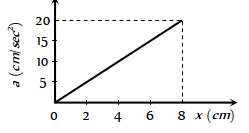
A $10 \mathrm{~kg}$ mass moves along $x$-axis. Its acceleration as a function of its position is shown in the figure. What is the total work done on the mass by the force as the mass moves from $x=0$ to $x=8 \mathrm{~cm}$
Image
There is an equiconvex glass lens with radius of each face as $R$ and ${ }_a \mu_g=3 / 2$ and ${ }_a \mu_w=4 / 3$. If there is water in object space and air in image space, then the focal length is