MCQ
Which is the example of hexadentate ligand
  • A
    $2, 2—$ dipyridyl
  • B
    Dimethyl glyoxime
  • C
    Aminodiacetate ion
  • Ethylene diammine tetra acetate ion $ [EDTA]$
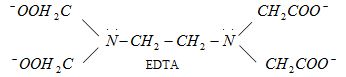
Answer

Correct option: D.
Ethylene diammine tetra acetate ion $ [EDTA]$
d
(d)

Need a full question paper?

Generate a complete, print-ready paper with questions like this in minutes — across 16+ boards, with answer keys.

Start Generating Free

Similar questions

When benzoic acid is treated with $PC{l_5}$ at $100\,^o C$, it gives
Which of the following pairs shows highest bond dissociation enthalpy among halogens and lowest bond dissociation enthalpy among] hydrogen halides?
Which of the following is a low-spin complex?
  Column $-I$ (various
solutions)
  Column $-II$
(Their freezing
point )
$a$ $0.1\,M$ $BaCl_2$ solution $p$ $271\,K$
$b$ $0.1\,M$ $NaCl$ solution $q$ $270\,K$
$c$ $0.1\,M\, K_3 [Fe(CN)_6]$ solution $r$ $268\,K$
$d$ $0.1\,M\, Al_2 (SO_4)_3$ solution $s$ $269\,K$

Given : Freezing point of $0.1\,M$ sucrose solution $= 272\,K$ and $F.pt.$ of water $= 273\,K$ 

Which of the following option show correct matches ?

Benzaldehyde reacts with ammonia to form
$C{H_3} - C{H_2} - C{H_2}Br + KOH{\rm{ (alc}}{\rm{.)}} \to {\rm{Product}}$

Product in above reaction is

Noble gases are absorbed by
When ethyl bromide is treated with moist $Ag_2O,$ main product is :
The rate coefficient $(k)$ for a particular reactions is $1.3 \times 10^{-4}\,M^{-1}\, s^{-1}$ at $100\,^oC,$ and $1.3 \times 10^{-3}\,M^{-1}\,s^{-1}$ at $150\,^oC$. What is the energy of activation $(E_A)$ (in $kJ$ ) for this reaction? ( $R =$ molar gas constant $= 8.314\,JK^{-1}\,mol^{-1}$ )
A reaction takes place in three steps with individual rate constant and activation energy, overall rate constant, $k = {\left( {\frac{{{k_1}{k_2}}}{{{k_3}}}} \right)^{2/3}}$ Then, overall activation energy of the reaction will be ........ $kJ /mol$

  Rate Constant Activation energy
Step $1$ $k_1$ $E_{a_1} = 180\ kJ/mol$
Step $2$ $k_2$ $E_{a_2} = 80\ kJ/mol$
Step $3$ $k_3$

$E_{a_3} = 50\ kJ/mol$