MCQ
Which is the factor that internal resistance does not depend on?
- ADistance between the electrodes.
- ✓Temperature of the electrolyte.
- CNature of electrode and electrolyte.
- DArea of the electrode, immersed in the electrolyte.
Internal resistance is defined as the resistance offered by the electrolyte and electrodes of a cell when the current flows through it. Internal resistance depends on distance between the electrodes, the nature of electrodes and electrolyte, and area of the electrode immersed in the electrolyte. So, that leaves temperature of the electrolyte out, which is the answer.
Generate a complete, print-ready paper with questions like this in minutes — across 16+ boards, with answer keys.
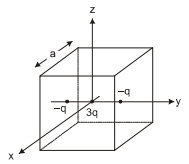
$(A)$ The net electric flux crossing the plane $x=+a / 2$ is equal to the net electric flux crossing the plane $x=-a / 2$.
$(B)$ The net electric flux crossing the plane $y=+a / 2$ is more than the net electric flux crossing the plane $y=-a / 2$
$(C)$ The net electric flux crossing the entire region is $\frac{q}{\varepsilon_0}$.
$(D)$ The net electric flux crossing the plane $z=+a / 2$ is equal to the net electric flux crossing the plane $x=+a / 2$.