Question
Which is the process used to harness nuclear energy these days? Explain it briefly.
Answer

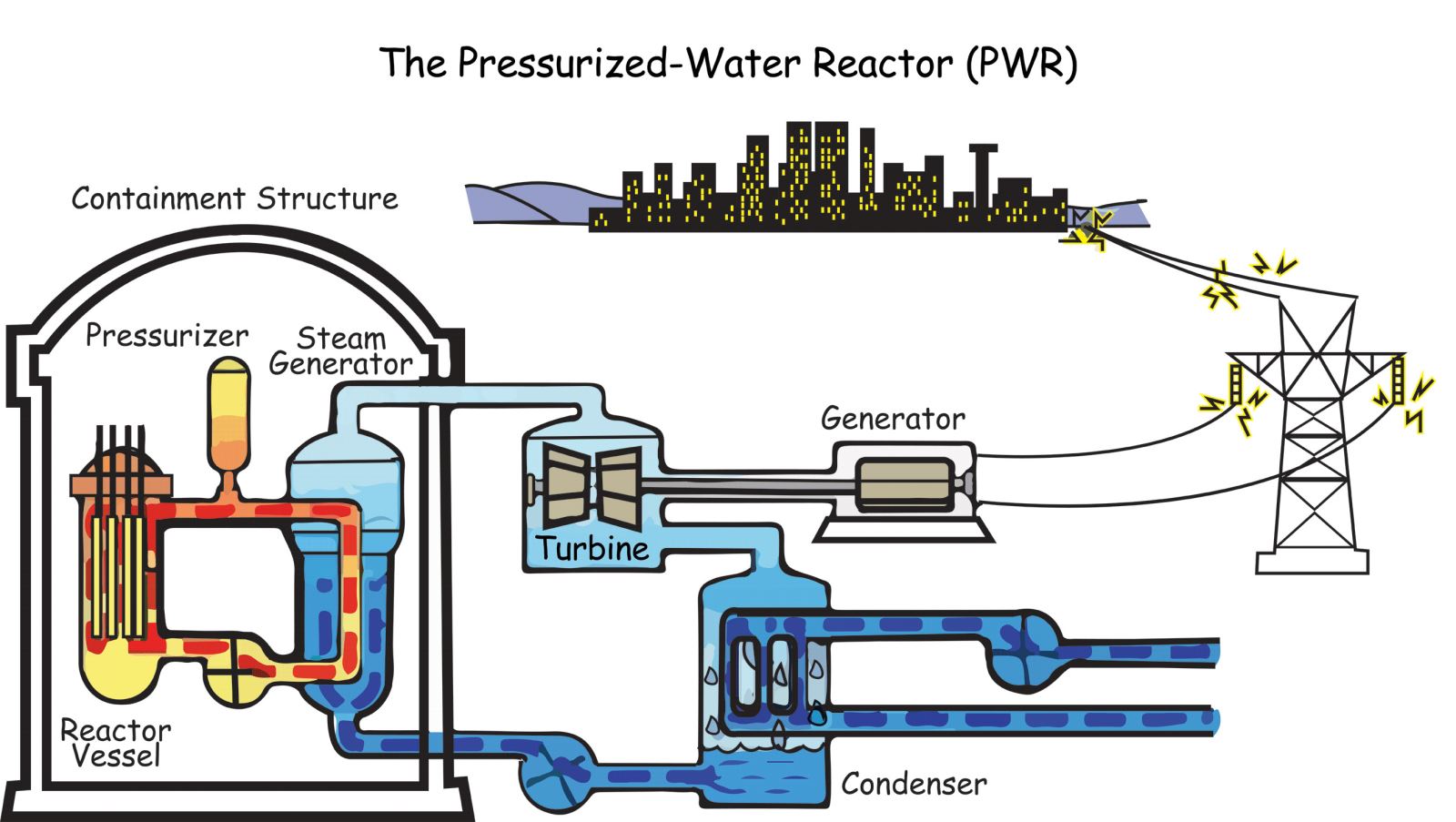
Nuclear energy is harnessed in nuclear power plants. It contains a nuclear reactor, a boiler and a turbine.
  • The nuclear reactor is the place where nuclear fission is carried out. Nuclear fission produces a huge amount of energy.
  • Energy produced during nuclear fission is utilized to boil water, so that steam can be generated.
  • Steam is utilized to turn the turbines to produce electricity.
The following figure shows the working of a nuclear power plant.

Need a full question paper?

Generate a complete, print-ready paper with questions like this in minutes — across 16+ boards, with answer keys.

Start Generating Free

Similar questions

A man bought a device X which could cook pulses, vegetables and rice without using any fuel like wood, coal, kerosene or LPG, etc. This device did not work at night. It also took a lot of time for cooking.
  1. Name the device X.
  2. What is the source of energy which cooks food in this device?
  3. What is the name of the process which traps energy in this device?
  4. State one advantage (other than saving on fuel) or using such a device for cooking food.
There are two important fuels A and B both of which are extracted from deep inside the earth. Fuel A is a thick, dark, foul smelling liquid whereas fuel B is a black solid. Combustion of both the fuels produces products, C, D, E and F. The product C makes the rainwater only slightly acidic but it is mainly responsible for causing global warming. The product D is neither acidic nor basic. It is harmless and does not affect the environment in any way. Both E and F attack breathing system of humans and are mainly responsible for causing acid rain. In addition to combustion of fuels A and B, the product F is also formed when lightning occurs in the sky.
  1. What are (i) fuel A, and (ii) fuel B?
  2. Name (i) C (ii) D (iii) E, and (iv) F?
  3. What is the process of formation of F during lightning known as?
  4. Which fuel is supposed to be exhausted sooner : A or B?
  5. Which fuel is mostly used for generating electricity at thermal power plants?
An element E exists in three allotropic forms A, B and C. In allotrope A, the atoms of element E are joined to form spherical molecules. In allotrope B, each atom of element E is surrounded by three other E atoms to form a sheet like structure. In allotrope C, each atom of element E is surrounded by four other E atoms to form a rigid structure.
  1. Name the element E.
  2. What is allotrope A.
  3. What is allotrope B?
  4. What is allotrope C?
  5. Which allotrope is used in making jewellery?
  6. Which allotrope is used in making anode of a dry cell?
When a high resistance voltmeter is connected directly across a resister its reading is 2V. An electric cell is sending the current of 0.4 A, (measured by an ammeter) in the electric circuit
in which a rheostat is also connected to vary the current.
  1. Draw an equivalent labelled circuit for the given data.
  2. Find the resistance of the resister.
  3. Name and state the law applicable in the given case. A graph is drawn between a set of values of potential difference (v) across the resister and current (I) flowing through it.
Show nature of graph thus obtained.
When metal X is treated with a dilute acid Y, then a gas Z is evolved which burns readily by making a little explosion.
  1. Name any two metals which can behave like metal X.
  2. Name any two acids which can behave like acid Y.
  3. Name the gas Z.
  4. Is the gas Z lighter than or heavier than air?
  5. Is the reaction between metal X and dilute acid Y, exothermic or endothermic?
  6. By taking a specific example of metal X and dilute acid Y, write a balanced chemical equation for the reaction which takes place. Also indicate physical states of all the reactants and products.
P and Q are two types of plants having weak stems which cannot stand upright on their own. The plants P and Q have organs R and S respectively which can grow towards any support which they happen to touch and wind around that support. It is observed that organ R originates from the leaves of the plant whereas organ S originates directly from the stem of the plant.
  1. What is (i) R, and (ii) S?
  2. What is the name of growth movement exhibited by the organs R and S?
  3. Name the stimulus involved in this case.
  4. State whether the behaviour of organs R and S is a tropic movement or a nastic movement.
  5. Name one plant like P and another plant like Q.
An object $4.0 \ cm$ in size, is placed $25.0 \ cm$ in front of a concave mirror of focal length $15.0 \ cm.$
$i.$ At what distance from the mirror should a screen be placed in order to obtain a sharp image?
$ii.$ Find the size of the image.
$iii.$ Draw a ray diagram to show the formation of image in this case.
The position of five elements in the periodic table are shown below:
  Group 1 Group 2 Group 16 Group 16
Period 1   A   B
Period 3 C   D E
What are the number of valence electrons in B?
Identify the element(s) which
  1. Will have the smallest atomic radius?
  2. Will be the most metallic?
  3. Will form basic oxide?
  4. Will show valency three?
  5. Will show greatest tendency to gain electron?
Bacteria have a simpler body plan when compared with human beings. Does it mean that human beings are more evolved than bacteria? Provide a suitable explanation.
You are given three resistances of 1,2 and 3 ohms. Show by diagrams, how with the help of these resistances you can get:
  1. $6\Omega$
  2. $\frac{6}{11}\Omega$
  3. $1.5\Omega$