Question
Which is the process used to harness nuclear energy these days? Explain it briefly.

Answer

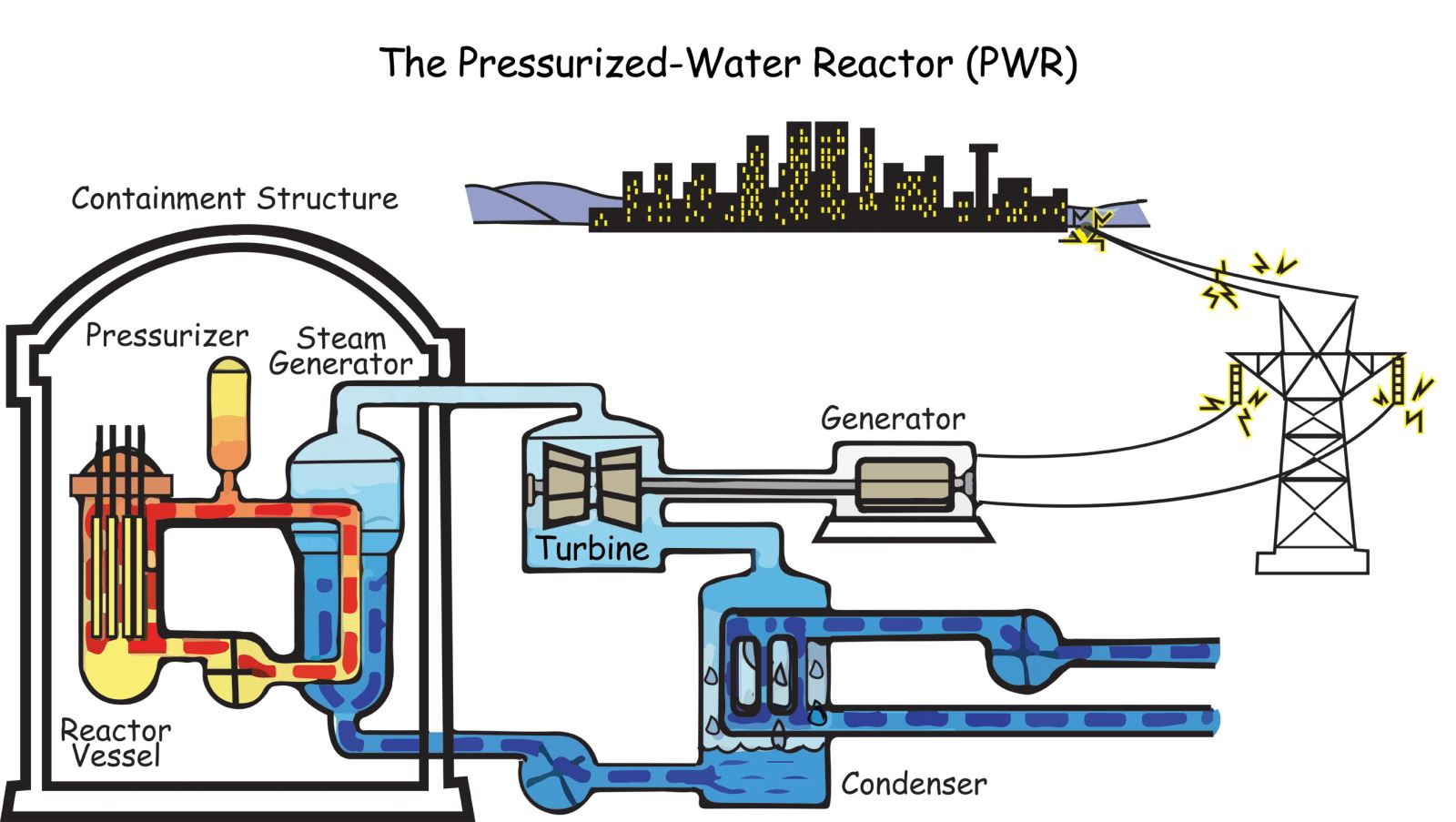
Nuclear energy is harnessed in nuclear power plants. It contains a nuclear reactor, a boiler and a turbine.
  • The nuclear reactor is the place where nuclear fission is carried out. Nuclear fission produces a huge amount of energy.
  • Energy produced during nuclear fission is utilized to boil water, so that steam can be generated.
  • Steam is utilized to turn the turbines to produce electricity.
The following figure shows the working of a nuclear power plant.

Need a full question paper?

Generate a complete, print-ready paper with questions like this in minutes — across 16+ boards, with answer keys.
Start Generating Free

Similar questions

Explain how deoxygenated blood travel from body to lung for purification. Draw well-labeled diagram in support of your answer.
Raina while doing certain reactions observed that heating of substance ' $X$ ' with vinegar like smell with a substance ' $Y$ ' (which is used as an industrial solvent) in presence of conc. Sulphuric acid on a water bath gives a sweet-smelling liquid ' $Z$ ' having molecular formula $C _4 H _8 O _2$. When heated with caustic soda $( NaOH )$, ' $Z$ ' gives back the sodium salt of and the compound ' $Y$ '
Identify ' $X$ ', ' $Y$ ', and ' $Z$ '. Illustrate the changes with the help of suitable chemical equations.
How do carbohydrates, fats and proteins get digested in human beings?
a) A doctor has advised Sameer to reduce sugar intake in his diet and do regular exercise after checking his blood test reports. Which disease do you think Sameer is suffering from? Name the hormone responsible for this disease and the organ producing the hormone.
b) Which hormone is present in the areas of rapid cell division in a plant and which hormone inhibits the growth?
What is a decomposition reaction? Give an example of a decomposition reaction. Describe an activity to illustrate such a reaction by heating.
  1. What is a homologous series of compounds? List any two characteristics of a homologous series.
  2.  
  1. What would be observed on adding a 5% solution of alkaline potassium permanganate solution drop by drop to some warm ethanol taken in a test tube?
  2. Write the name of the compound formed during the chemical reaction.
  1. How would you distinguish experimentally between an alcohol and a carboxylic acid on the basis of a chemical property?
A worm X found in freshwater and slow-moving streams has been accidently cut into three pieces. It was observed that in due course of time, each cut piece of the worm develops to become a complete worm by growing all the missing parts.
  1. Name the worm X which can exhibit this phenomenon of making complete worm from its cut body parts.
  2. Name another organism Y which possesses the same characteristic of growing fully from its cut body parts.
  3. What is the name of this process in which a complete organism is formed from its cut body part.
  4. State whether X and Y are unicellular and/or multicellular organisms.
  5. Can a dog be produced completely form its cut body part (say, a cut tail) just like organisms X and Y? Why?
Explain the difference between each of the following pairs of terms:
  1. Receptor and effector.
  2. Cerebrum and cerebellum.
Explain natural vegetative propagation by roots in plants.
  1. Draw the structure of a neuron and label the following on it: Nucleus, Dendrite, Cell body and Axon.
  2. Name the part of neuron:
  3. Where information is acquired.
  4. Through which information travels as an electrical impulse.