MCQ
Which is the strongest acid ($pk_a$ value is given)?
  • $HCOOH\, [3.77]$
  • B
    $C_6H_5COOH\, [4.22]$
  • C
    $CH_3COOH\, [4.7]$
  • D
    $CH_3CH_2COOH \,[4.88]$

Answer

Correct option: A.
$HCOOH\, [3.77]$
a
\because Strength of acid $ \propto \frac{1}{{p{k_a}}}$
\therefore Formic acid will be the strongest acid.

Need a full question paper?

Generate a complete, print-ready paper with questions like this in minutes — across 16+ boards, with answer keys.
Start Generating Free

Similar questions

Acetylene is obtained by the electrolysis of
Aromaticity is present in
Electronegativity is a measure of the capacity of an atom to
The element with which of the following outer electron configuration may exhibit the largest number of oxidation states in its compounds 
The $pH$ of $0.001 $ molar solution of $HCl$ will be
The amount of water produced (in $g$ ) in the oxidation of $1$ mole of rhombic sulphur by conc. $HNO _3$ to a compound with the highest oxidation state of sulphur is. . . . .  (Given data : Molar mass of water $=18 g mol ^{-1}$ )
The electronic configuration (outermost) of $M{n^{ + 2}}$ ion (atomic no. of $Mn = 25$) in its ground state is
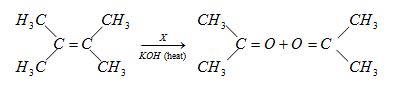
$X$ in the above reaction is
Which of the following set of quantum number is not possible

         $n$                $l$             $m_1$                $m_2$    

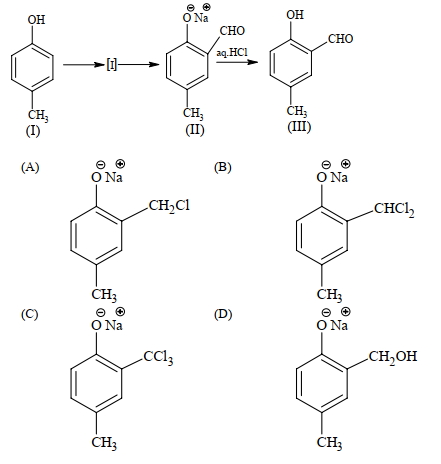
Reimer-Tiemann reaction introduces an aldehyde group, on to the aromatic ring of phenol, ortho to the hydroxyl group. This reaction involves electrophilic aromatic substitution. This is a general method for the synthesis of substituted salicyladehydes as depicted below.

$Image$

$1.$ Which one of the following reagents is used in the above reaction?

$(A)$ aq. $\mathrm{NaOH}+\mathrm{CH}_3 \mathrm{Cl}$

$(B)$ aq. $\mathrm{NaOH}+\mathrm{CH}_2 \mathrm{Cl}_2$

$(C)$ aq. $\mathrm{NaOH}+\mathrm{CHCl}_3$

$(D)$ aq. $\mathrm{NaOH}+\mathrm{CCl}_4$

$2.$ The electrophile in this reaction is

$(A)$ : $\mathrm{CHCl}$ $(B)$ ${ }^{+} \mathrm{CHCl}_2$

$(C)$ $\mathrm{CCl}_2$ $(D)$. $\mathrm{CCl}_3$

$3.$ The structure of the intermediate $I$ is

$Image$

Give the answer question $1, 2$ and $3.$