MCQ
Which is true about $H_3BO_3$
  • A
    Soluble in water at low temperature
  • B
    Tribasic acid
  • C
    Forms when borax react with a base
  • None

Answer

Correct option: D.
None
d
Soluble in hot water, monobasic forms when borax reacts with acid.

Need a full question paper?

Generate a complete, print-ready paper with questions like this in minutes — across 16+ boards, with answer keys.

Start Generating Free

Similar questions

The following statements concern elements in the periodic table. Which of the following is true ?
The structure of iron pentacarbonyl is:
The values of $K_p/K_c$ for the following reactions at $300\, K$ are respectively (At $300\, K, RT = 24.62\, dm^3\, atm \,mol^{-1}$)

${N_2}(g) + {O_2}(g) \rightleftharpoons  2NO(g)$

${N_2}{O_4}(g) \rightleftharpoons  2N{O_2}(g)$

${N_2}(g) + 3{H_2}(g) \rightleftharpoons  2N{H_3}(g)$

The substances used for the preparation of ether by Williamson's synthesis are
$n-$ hexane $\xrightarrow{{catalyst}}$ benzene

catalyst is

Which of the following statement is correct ?
If isobutane and $n-$ butane are present in a gas, then how much oxygen should be required for complete combusition of $10\,kg$ of this gas ........... $\mathrm{kg}$
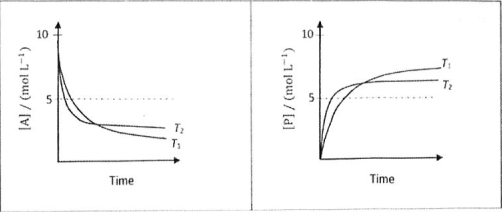
For a reaction, $A \rightleftharpoons P$, the plots of $[ A ]$ and $[ P ]$ with time at temperatures $T _1$ and $T _2$ are given below.

If $T _2> T _1$, the correct statement(s) is (are)

(Assume $\Delta H ^{\ominus}$ and $\Delta S ^{\ominus}$ are independent of temperature and ratio of $\ln K$ at $T _1$ to $\ln K$ at $T_2$ is greater than $T_2 / T_1$. Here $H, S, G$ and $K$ are enthalpy, entropy, Gibbs energy and equillibrium constant, respectively.)

$(A)$ $\Delta H ^{\ominus}<0, \Delta S ^{\ominus}<0$  $(B)$ $\Delta G ^{\ominus}<0, \Delta H ^{\ominus}>0$  $(C)$ $\Delta G ^{\ominus}<0, \Delta S ^{\ominus}<0$  $(D)$ $\Delta G ^{\ominus}<0, \Delta S ^{\ominus}>0$
For which of the following ionic species radius would be maximum ?
The value of $K_P$ for the equilibrium reaction ${N_2}{O_4}(g)\, \rightleftharpoons \,2N{O_2}(g)$ is $2.$ The percentage dissociation of $N_2O_4(g)$ at a pressure of $0.5\,atm$ is