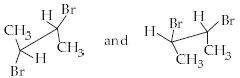
MCQ
Which $L$ -sugar on oxidation gives an optically active dibasic acid
- ✓
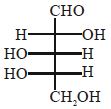
- B
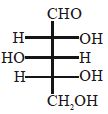
- C
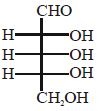
- D
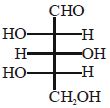
As only $(a)$ and $(d)$ are $L$-sugar, $(b)$ and $(c)$ are $D$-sugar after oxidation.
$(a)$ (Refer to Image $1$)
As the product do not superimpose in its mirror image.
$(d)$ (Refer to Image $2$)
As it has plane of symmetry.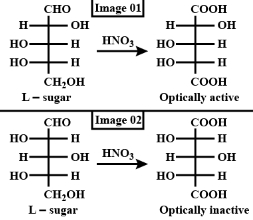
Generate a complete, print-ready paper with questions like this in minutes — across 16+ boards, with answer keys.
The possible reagents are :
$(I)\, 2Na/liq.NH_3$ $(II)\, H_2 /Pd/CaCO_3$ (quinoline) $(III)\, 2H_2 / Pd /C$
The correct statement with respect to the above conversion is/are
(Round off to the Nearest Integer).