Question
Which methodology is used while sequencing the total DNA from a cell? Explain it in detail.

Answer

Methodologies of HGP:

The methods involve two major approaches:

  1. Expressed sequence tags (ESTs): This method focusses on identifying all the genes that are expressed as RNA.

  2. Sequence annotation: It is an approach of simply sequencing the whole set of genome that contains all the coding and non-coding sequences, and later assigning different regions in the sequence with functions.

  • For sequencing, the total DNA from cell is first isolated and broken down in relatively small sizes as fragments.
  • These DNA fragments are cloned in suitable host using suitable vectors. When bacteria is used as vector, they are called bacterial artificial chromosomes (BAC) and when yeast is used as vector, they are called yeast artificial chromosomes (YAC).
  • Frederick Sanger developed a principle according to which the fragments of DNA are sequenced by automated DNA sequences.
  • On the basis of overlapping regions on DNA fragments, these sequences are arranged accordingly.
  • For alignment of these sequences, specialised computer-based programmes were developed.
  • Finally, the genetic and physical maps of the genome were constructed by collecting information about certain repetitive DNA sequences and DNA polymorphism, based on endonuclease recognition sites.

Need a full question paper?

Generate a complete, print-ready paper with questions like this in minutes — across 16+ boards, with answer keys.
Start Generating Free

Similar questions

DNA separated from one cell, when introduced in another cell, is able to bestow some of the properties of the former to the latter. What is this change called in technical terms? Describe the experiment evidences which led to the discovery of the above phenomenon.
(a) Describe the observations made on collection of white winged moths and dark winged moths in England between the years 1850 and 1920. What did these observations lead to?
(b) How is the use of herbicides, pesticides and antibiotics by humans for various, comparable with the observations made on moths in the above question? What is this type of phenomenon called?
Answer the following questions:
Describe the stages in embryo development in a dicot plant.
What is Immunity. Differentiate between active and passive immunity. Draw a labelled diagram of antibody molecule.
Explain the relationship of ribosomes, 1-RNA and m-RNA during the process of translation in Prokaryotes.
(i) Define translation.
(ii) Explain the translation process.
(iii) Draw a labelled diagram of the translation.
  1. Draw the pyramids of biomass in a pond and in a forest. Explain giving reasons why the two pyramids are different.
  2. Pyramid of energy is always upright. Explain.
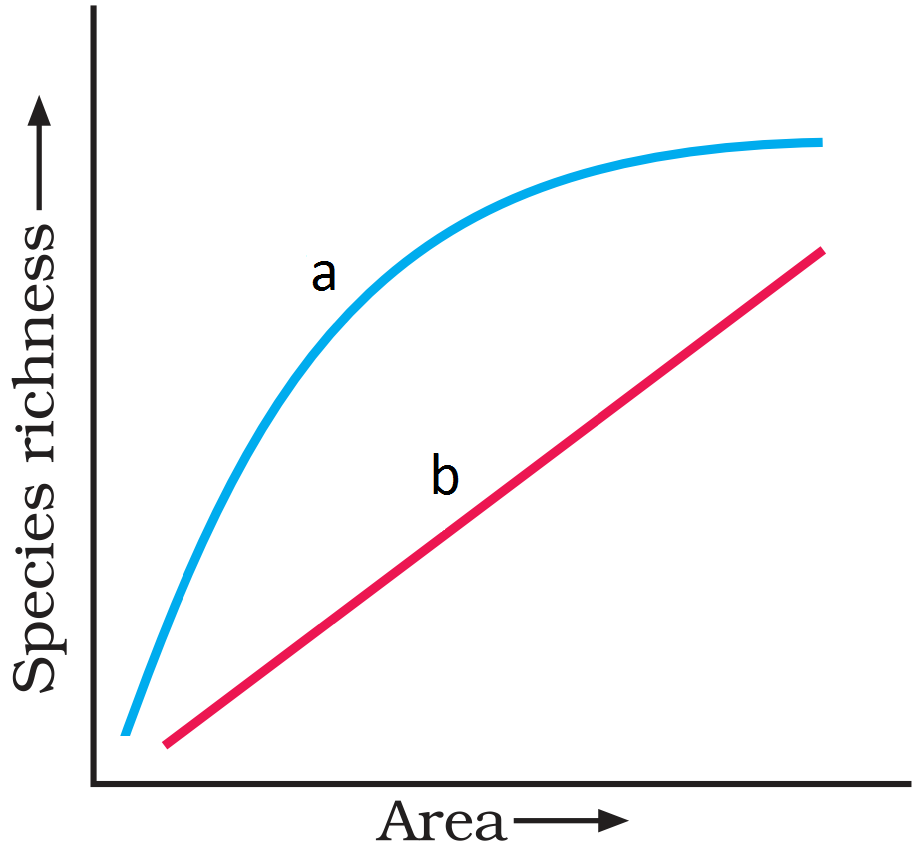
The graph shows species-area relationship:

  1. If b denotes the relationship on log scale-
  1. Describe a and b.
  2. How is slope represented? Give the normal range of slope.
  3. What kind of slope will be observed for frugivorous birds and mammals in a tropical forest?
  1. Species diversity of plants (22%) is much less than that of animals (72%). Analyze the reasons for greater diversity of animals as compared to plants.


Define aneuploidy. How is it different from polyploidy? Describe the individuals having following chromosomal abnormalities.
  1. Trisomy of 21st Chromosome.
  2. XXY.
  3. XO.
Describe the roles of pituitary and ovarian hormones during the menstrual cycle in a human female.