MCQ
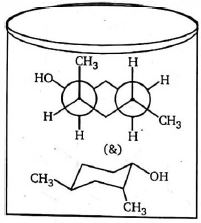
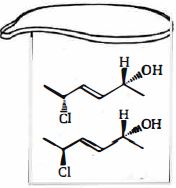
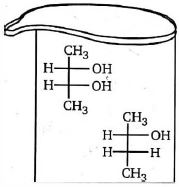
Which mixture of structure in each beaker would rotate plane polarized light?
  • A

  • B

  • C

  • All of these

Answer

Correct option: D.
All of these
d
$(d)$ Chiral mixture would rotate plane polarized light

Need a full question paper?

Generate a complete, print-ready paper with questions like this in minutes — across 16+ boards, with answer keys.
Start Generating Free

Similar questions

Which of the following can act both as an oxidising as well as reducing agent ?
Which of the following is most common source of vitamin $C$ ?
The correct order of decreasing basic strengths of $x, y$ and $z$ is
Given below are the two statements: one is labeled as Assertion (A) and the other is labeled as Reason (R).
Assertion (A):There is a considerable increase in covalent radius from N to P. However from As to Bi only a small increase in covalent radius is observed.
Reason (R): covalent and ionic radii in a particular oxidation state increases down the group.
In the light of the above statement, choose the most appropriate answer from the options given below:
For the gaseous reactions Calculate the approxmate value of temperature at which $k_1 = k_2$ .  $[ln\, 10 = 2.3]$ ......... $K$

$A \to B$            ${K_1} = {10^{15}}{e^{ - 25000/8.314\,T}}$

$C \to D$           ${K_2} = {10^{14}}{e^{ - 15000/8.314\,T}}$

Correct order of basic strength is:
Not considering the electronic spin, the degeneracy of the second excited state $( n =3)$ of $H$ atom is $9$ , while the degeneracy of the second excited state of $H ^{-}$is
 Highest enol content will be shown by :
The dissociation constants for acetic acid and $HCN$ at $25\,^oC$ are $1.5 \times 10^{-5}$ and $4.5 \times 10^{-10} $ respectively. The equilibrium constant for the equilibrium  $CN^- + CH_3COOH \rightleftharpoons HCN+ CH_3COO^-$ would be
For which of the following reactions, $\Delta H$ is equal to $\Delta U$ ?