MCQ
Which of following is correct :
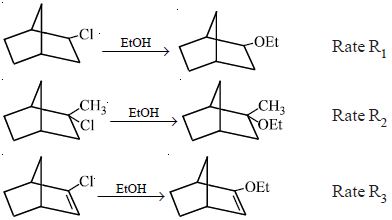
  • A
    $R_1 > R_2 > R_3$
  • B
    $R_3 > R_2 > R_1$
  • $R_2 > R_1 > R_3$
  • D
    $R_2 > R_3 > R_1$

Answer

Correct option: C.
$R_2 > R_1 > R_3$
c

Need a full question paper?

Generate a complete, print-ready paper with questions like this in minutes — across 16+ boards, with answer keys.

Start Generating Free

Similar questions

$p-$ cresol reacts with chloroform in alkaline medium to give the compound $A$ which adds hydrogen cyanide to form, the compound $B$. The latter on acidic hydrolysis gives chiral carboxylic acid. The structure of the carboxylic acid is
On the electrolysis of aqueous solution of sodium sulphate, on cathode we get
Alcoholic potash is used to bring about
$CHC{l_3}$ and  $ HF$  lead to the formation of a compound of fluorine of molecular weight $70$ . The compound is
Match List $-I$ with List $- II$

List $- I$ Electronic configuration of elements

List $- II$ $\Delta_{ i }$ in $kJ\, mol-1$

$(a)$ $1 s ^{2} 2 s ^{2}$ $(i)$ $801$
$(b)$ $1 s ^{2} 2 s ^{2} 2 p ^{4}$ $(ii)$ $899$
$(c)$ $1 s^{2} 2 s^{2} 2 p^{3}$ $(iii)$ $1314$
$(d)$ $1 s ^{2} 2 s ^{2} 2 p ^{1}$ $(iv)$ $1402$

Choose the most appropriate answer from the options given below
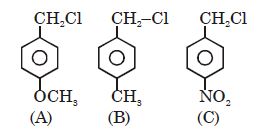
Rate of ${S_{{N^1}}}$ in given compound is
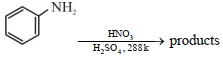
With respect to the following reaction, consider the given statements :

$[Image]$

$(A)$ $o-$Nitroaniline and $p-$nitroaniline are the predominant products

$(B)$ $p-$Nitroaniline and $m-$nitroaniline are the predominant products

$(C)$ $HNO _{3}$ acts as an acid

$(D)$ $H _{2} SO _{4}$ acts as an acid
The Henry law constant for dissolution of a gas in aqueous medium is $3 × 10^2$  $atm$. At what partial pressure of the gas, the molality of gas in aqueous solution will be $\frac{5}{9}\,m$.
A gaseous mixture was prepared by taking equal mole of $CO$ and $N_2$ . If the total pressure of the mixture was found $1$ atmosphere, the partial pressure of the nitrogen $(N_2)$ in the mixture is ......... $atm$.
On dissolving sugar in water at room temperature solution feels cool to touch. Under which of the following cases dissolution of sugar will be most rapid?