MCQ
Which of one is correct
  • ${E^2} = {p^2}{c^2}$
  • B
    ${E^2} = {p^2}c$
  • C
    ${E^2} = p{c^2}$
  • D
    ${E^2} = {p^2}/{c^2}$

Answer

Correct option: A.
${E^2} = {p^2}{c^2}$
a
(a) Momentum $p = \frac{E}{c}\, \Rightarrow \,{E^2} = {p^2}{c^2}$

Need a full question paper?

Generate a complete, print-ready paper with questions like this in minutes — across 16+ boards, with answer keys.

Start Generating Free

Similar questions

A charged particle of mass $m$ and charge $q$ is released from rest in a uniform electric field $E.$ Neglecting the effect of gravity, the kinetic energy of the charged particle after ‘$t$’ second is
Ozone layer protects us from which harmful radiations coming from the sun?
The energy stored in a $50 \,mH$ inductor carrying a current of $4 \,A$ will be....$J$
An infinite nonconducting sheet of charge has a surface charge density of $10^{-7}\  C/m^2$. The separation between two equipotential surfaces near the sheet whose potential differ by $ 5\,V$  is
In Young's double slit experiment, the phase difference between the light waves reaching third bright fringe from the central fringe will be (λ =6000 Å )
If the current is doubled, the deflection is also doubled in
Which of the following statement is false for the properties of electromagnetic waves ?
Which figure shows the correct variation of applied potential difference $(V)$ with photoelectric current $(I)$ at two different intensities of light ( $\mathrm{I}_1<$ $\mathrm{I}_2$ ) of same wavelengths :
A 700 pF capacitor is charged by a 50 V battery. The electrostatic energy stored by it is
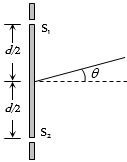
In an interference arrangement similar to Young's double slit experiment, the slits $S_1$ and $S_2$ are illuminated with coherent microwave sources each of frequency $10^6 Hz$. The sources are synchronized to have zero phase difference. The slits are separated by distance $d = 150\, m$. The intensity I$(\theta )$is measured as a function of $\theta$, where $\theta$ is defined as shown. If $I_0$ is maximum intensity, then $I(\theta )$ for $0 \le \theta \le {90^o}$is given by