MCQ
Which of the acids cannot be prepared by Grignard reagent
  • A
    Acetic acid
  • B
    Succinic acid
  • Formic acid
  • D
    All of these

Answer

Correct option: C.
Formic acid
c
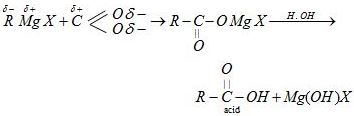
(c)Formic acid can not be prepared by grignard’s reagent. Higher acids are prepared by the reaction of $C{O_2}$ on grignard’s reagent


Need a full question paper?

Generate a complete, print-ready paper with questions like this in minutes — across 16+ boards, with answer keys.

Start Generating Free

Similar questions

Number of chiral carbons in $\beta - D - ( + )$ - glucose is
Mendeleef's periodic law is based on
The thermal dissociation equilibrium of $CaCO _3( s )$ is studied under different conditions.

$CaCO _3( s ) \rightleftharpoons CaO ( s )+ CO _2( g )$

For this equilibrium, the correct statement(s) is (are)

$(A)$ $\Delta H$ is dependent on $T$

$(B)$ $K$ is independent of the initial amount of $CaCO _3$

$(C)$ $K$ is dependent on the pressure of $CO _2$ at a given $T$

$(D)$ $\Delta H$ is independent of the catalyst, if any

Which of the following is $INCORRECT$ match for the suitable enzyme catalyst of the given reaction
The electronic configuration of an element is $1{s^2},\,2{s^2}\,2{p^6},\,3{s^2}\,3{p^3}$. What is the atomic number of the element which is just below the above element in the periodic table
In the reaction sequence, $[X]$ is ketone :

$[X]$ $\xrightarrow{{KMn{O_4}/\mathop O\limits^\Theta  H/\Delta }}$ $\begin{array}{*{20}{c}}
  {\begin{array}{*{20}{c}}
  {\begin{array}{*{20}{c}}
  {\,\,\,\,\,\,\,\,\,\,\,\,\,\,\,\,\,\,\,\,\,\,\,\,\,\,\,\,C{H_3}} \\ 
  {\,\,\,\,\,\,\,\,\,\,\,\,\,\,\,\,\,\,\,\,\,|} \\ 
  {HOOC - {{(C{H_2})}_3} - CH - COOH} 
\end{array}} 
\end{array}} 
\end{array}$

$[X]$ will be:

At $100\,^oC,$ the gaseous reaction $A \rightarrow 2B + C$ is found to be first order. Starting with pure $A,$ if at the end of $10\,\min$, the total pressure of the system is $160\, mm$ and after a long time, when dissociation of $A$ was complete, it was $300\, mm.$ The partial pressure of $A$ at the end of $10\,\min$ is .......... $mm$
The reaction, ${N_2}{O_5} \longrightarrow 2NO + \frac{1}{2}\,{O_2}$ is of first order for $N_2O_5$ with rate constant $6.2 \times 10^{-4}\, s^{-1}$. what is the value of rate of reaction when $[N_2O_5] = 1.25\, mol\, L^{-1}$
Which one of the following undergoes nucleophilic aromatic substituion at the fastest rate ?
The $pH$ of blood does not appreciably change by a small addition of acid or a base because blood