Question
Which of the following about potential difference between any two points is true?
  1. It depends only on the initial and final position.
  2. It is the work done per unit positive charge in moving from one point to other.
  3. It is more for a positive charge of two units as compared to a positive charge of one unit.
Answer

  1. I and II.

Need a full question paper?

Generate a complete, print-ready paper with questions like this in minutes — across 16+ boards, with answer keys.

Start Generating Free

Similar questions

The wave theory of light does not explain:
In the valance band, the current is due to:
Which of the following statements is not correct according to Rutherford model?
The amount of charge required to liberate 9 gm of aluminium (atomic weight = 27 and  valency = 3) in the process of electrolysis is (Faraday's number = 96500 coulombs/gm equivalent)(a) 321660 coulombs(b) 69500 coulombs(c) 289500 coulombs(d) 96500 coulombs
       
A point object O is placed on the principal axis of a convex lens of focal length f = 20cm at a distance of 40cm to the left of it. The diameter of the lens is 10cm. An eye is placed 60cm to right of the lens and a distance h below the principal axis. The maximum value of h to see the image is:
  1. 0
  2. 2.5cm
  3. 5cm
  4. 10cm.
The polarisation of electromagnetic wave is in:
If two streams of protons move parallel to each other in the same direction, then they(a) Do not exert any force on each other(b) Repel each other(c) Attract each other(d) Get rotated to be perpendicular to each other


In a radioactive substance at $t = 0,$ the number of atoms is $8 \times 10^4.$ Its half life period is $3$ years. The number of atoms $1 \times 10^4$ will remain after interva
The plate current in a diode is zero. It is possible that:
  1. The plate voltage is zero.
  2. The plate voltage is slightly negative.
  3. The plate voltage is slightly positive.
  4. The temperature of the filament is low.
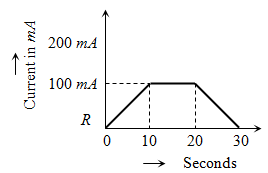
In a copper voltameter, mass deposited in $30$ second is $m \ gm.$ If the time$-$current graph is as shown in figure, $\text{ECE}$ of copper is