MCQ
Which of the following about potential difference between any two points is true?
  1. It depends only on the initial and final position.
  2. It is the work done per unit positive charge in moving from one point to other.
  3. It is more for a positive charge of two units as compared to a positive charge of one unit.
    • A
      I only.
    • B
      II only.
    • C
      I and II.
    • D
      I, II and III.

    Answer

    1. I and II.

    Need a full question paper?

    Generate a complete, print-ready paper with questions like this in minutes — across 16+ boards, with answer keys.

    Start Generating Free

    Similar questions

    If convex lens of focal length 80cm and a concave lens of focal length 50 cm are combined together, what will be their resulting power

    (a) + 6.5 D

    (b) – 6.5 D

    (c) + 7.5 D

    (d) – 0.75 D

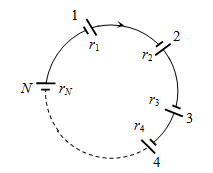
    A group of N cells whose emf varies directly with the internal resistance as per the equation EN = 1.5 rN are connected as shown in the figure below.  The current I in the circuit is

    (a) 0.51 amp

    (b) 5.1 amp

    (c) 0.15 amp

    (d) 1.5 amp

    NPN transistor are preferred to PNP transistor because they have

    (a) Low cost

    (b) Low dissipation energy

    (c) Capability of handing large power

    (d) Electrons having high mobility than holes

     What is the full form of UHF?

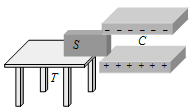
    A frictionless dielectric plate S is kept on a frictionless table  T. A charged parallel plate capacitance  C (of which the plates are frictionless) is kept near it. The plate S is between the plates. When the plate S is left between the plates

    (a) It will remain stationary on the table

    (b) It is pulled by the capacitor and will pass on the other end

    (c) It is pulled between the plates and will remain there

    (d) All the above statements are false

    Demagnetisation of magnets can be done by

    (a) Rough handling

    (b) Heating

    (c) Magnetising in the opposite direction

    (d) All the above

    A long, straight wire carries a current i. The magnetizing field intensity H is measured at a point P close to the wire. A long, cylindrical iron rod is brought close to the wire so that the point P is at the centre the rod. The value of H at P will:
    1. Increase many times.
    2. Decrease many times
    3. Remain almost constant.
    4. Become zero.
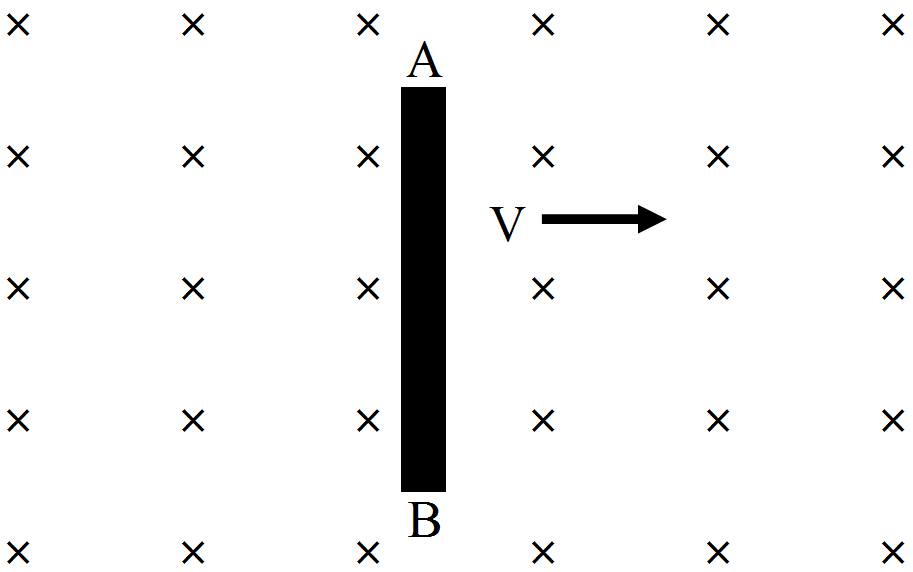
    A rod AB moves with a uniform velocity v in a uniform magnetic field as shown in figure.
    1. The rod becomes electrically charged.
    2. The end A becomes positively charged.
    3. The end B becomes positively charged.
    4. The rod becomes hot because of Joule heating.

    A piece of semiconductor is connected in series in an electric circuit. On increasing the temperature, the current in the circuit will

    (a) Decrease

    (b) Remain unchanged

    (c) Increase

    (d) Stop flowing

    A diode, a resistor and a 50Hz AC source are connected in series. The number of current pulses per second through the resistor is: