MCQ
Which of the following are secondary bromides?
  • A
    (CH3)2CHBr
  • B
    (CH3)3C CH2Br
  • C
    CH3CH(Br)CH2CH3
  • D
    (CH3)2CBrCH2CH3

Answer

  1. (CH3)2 CHBr
  1. CH3CH(Br)CH2CH3

Explanation:

Secondary bromides are bromides where the bromo group (-Br) is bonded to a secondary or 2-degree carbon atom. (i.e. 2oC).Thus in,

(CH3)2CHBr – Bromide group is attached to sec –carbon or 2oC. CH3CH(Br)CH2CH3- here also, the Bromide group is attached to sec- carbon or 2oC.

Need a full question paper?

Generate a complete, print-ready paper with questions like this in minutes — across 16+ boards, with answer keys.
Start Generating Free

Similar questions

Consider the reaction, $2A + B \rightarrow$ products. When concentration of $B$ alone was doubled, the half-life did not change. When the concentration of $A$ alone was doubled, the rate increased by two times. The unit of rate constant for this reaction is
The chemical reaction, $2AgCl(s) + {H_2}(g)\; \to $ $2HCl(aq) + 2Ag(s)$ taking place in a galvanic cell is represented by the notation
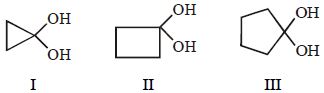
Arrange the stability of given gemdiols in decreasing order
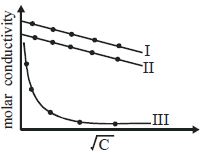
A graph was plotted between molar conductivity of various electrolytes ($NaCl, HCl$ and $NH_4OH$) and $\sqrt{C}$ (in $mol\, L^{-1}$). Correct setting
Number of isomeric primary amines obtained from ${C_4}{H_{11}}N$ are
Which of the following on reaction with $N{H_3}$ gives urinary antiseptic compound
When $MnO_2$ is fused with $KOH,$ a coloured compound is formed. The product and its colours is ?
For the reaction : $2A + B \to  A_2B$ ; the rate $= K[A]\, [B]^2$ with $K = 2.0\times10^{-6}\, lit^2\, mol^{-2}\, sec^{-1}$. Initial concentration of $A$ and $B$ are $0.2\, mol/lit$ and $0.4\, mol/lit$ respectively. Calculate the rate of reaction after $[A]$ is reduced to $0.12\, mol/litre$.
An organic compound $'A'$ $(C_{9} H _{10} O$ ) when treated with conc. $HI$ undergoes cleavage to yield compounds $'B'$ and $'C'.$ $'B'$ gives yellow precipitate with $AgNO _{3}$ where as $'C'$ tautomerizes to $D ^{\prime} .$ $'D'$ gives positive idoform test. $'A'$ could be :
A Substance undergoes first order decomposition. The decomposition follows two parallel first order reactions asThe percentage distribution of $B$ and $C$  are

$A\,\xrightarrow{{{k_1}}}B$        ${k_1}\, = \,1.26\, \times \,{10^{ - 4}}\,{S^{ - 1}}$

$A\,\xrightarrow{{{k_2}}}C$       ${k_2}\, = \,3.8\, \times \,{10^{ - 5}}\,{S^{ - 1}}$