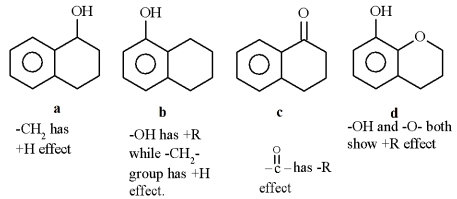
MCQ
Which of the following cannot act as Nucleophile?
  • A
    $NH_3$
  • B
    $\mathop O\limits^\Theta  H$
  • $: CCl_2$
  • D
    $\mathop C\limits^\Theta  N$

Answer

Correct option: C.
$: CCl_2$
c
Benzene becomes more reactive towards EAS when any substituent raises the electron density.

Need a full question paper?

Generate a complete, print-ready paper with questions like this in minutes — across 16+ boards, with answer keys.

Start Generating Free

Similar questions

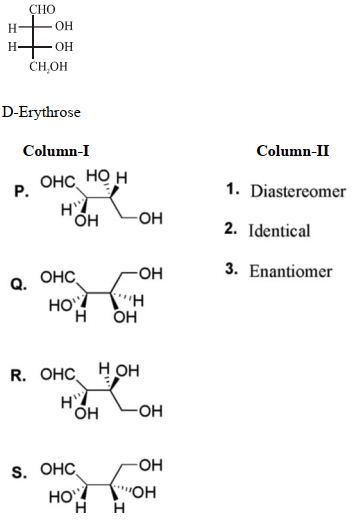
The Fischer projection of $D$-erythrose is shown below.

(image)

$D$-Erythrose and its isomers are listed as $P , Q , R$, and $S$ in Column-$I$. Choose the correct relationship of $P , Q , R$, and $S$ with D-erythrose from Column $II$.

(image)
With respect to graphite and diamond, which of the statement$(s)$ given below is (are) correct?

$(A)$ Graphite is harder than diamond.

$(B)$ Graphite has higher electrical conductivity than diamond

$(C)$ Graphite has higher thermal conductivity than diamond

$(D)$ Graphite has higher $C$ - $C$ bond order than diamond
Which one of the following compounds shows optical isomerism
Number of moles of ${K_2}C{r_2}{O_7}$ reduced by one mole of $S{n^{2 + }}$ ions is
A hydrocarbon of formula ${C_6}{H_{10}}$ absorbs only one molecule of ${H_2}$ upon catalytic hydrogenation. Upon ozonolysis, the hydrocarbon yields $\begin{array}{*{20}{c}}
  {\,H\,\,\,\,\,\,\,\,\,\,\,\,\,\,\,\,\,\,\,\,\,\,\,\,\,\,\,\,\,\,\,\,\,\,\,\,\,\,\,\,\,\,\,\,\,\,\,\,\,\,\,\,\,\,\,\,\,\,\,\,\,\,\,\,\,\,\,\,\,\,\,\,\,\,\,\,\,\,\,\,\,\,\,\,H} \\ 
  {|\,\,\,\,\,\,\,\,\,\,\,\,\,\,\,\,\,\,\,\,\,\,\,\,\,\,\,\,\,\,\,\,\,\,\,\,\,\,\,\,\,\,\,\,\,\,\,\,\,\,\,\,\,\,\,\,\,\,\,\,\,\,\,\,\,\,\,\,\,\,\,\,\,\,\,\,\,\,\,\,\,\,\,\,\,\,\,|} \\ 
  {O = C - C{H_2} - C{H_2} - C{H_2} - C{H_2} - C = O} 
\end{array}$ The hydrocarbon is
The pairs of bases in $DNA$ are held together by
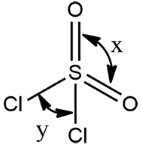
Compare $x$ and $y$  bond angles in the following molecule
Any precipitate is formed when
If electron, hydrogen, helium and neon nuclei are all moving with the velocity of light, then the wavelengths associated with these particles are in the order
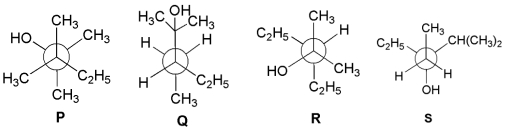
Newman projections $P , Q , R$ and $S$ are shown below :

Which one of the following options represents identical molecules?