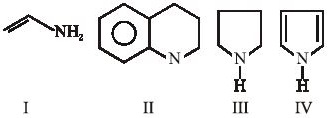
MCQ
Which of the following cannot undergo $E_2$ reaction?
- A

- B

- ✓

- Dnone of these
Generate a complete, print-ready paper with questions like this in minutes — across 16+ boards, with answer keys.
The time taken for $A$ to become $1 / 4^{\text {th }}$ of its inital concentration is twice the time taken to become $1 / 2$ of the same. Also, when the change of concentration of $B$ is plotted against time, the resulting graph gives a straight line with a negative slope and a positive intercept on the concentration axis. The overall order of the reaction is . . . . .
Statement $I :$ $o-$Nitrophenol is steam volatile due to intramolecular hydrogen bonding.
Statement $II :$ $o-$Nitrophenol has high melting due to hydrogen bonding.
In the light of the above statements, choose the most appropriate answer from the options given below
Assertion $(A)$ : $\mathrm{PH}_3$ has lower boiling point than $\mathrm{NH}_3$.
Reason $(R)$ : In liquid state $\mathrm{NH}_3$ molecules are associated through vander waal's forces, but $\mathrm{PH}_3$ molecules are associated through hydrogen bonding. In the light of the above statements, choose the most appropriate answer from the options given below: