MCQ
Which of the following complex ion shows optical isomers?
  • A
    $\left[ ZnCl _4\right]^{2-}$
  • B
    $\left[ Co ( CN )_6\right]^{3-}$
  • C
    $\left[ Cu \left( NH _3\right)_4\right]^{2+}$
  • $\left[ Cr \left( C _2 O _4\right)_3\right]^{3-}$

Answer

Correct option: D.
$\left[ Cr \left( C _2 O _4\right)_3\right]^{3-}$
d

Need a full question paper?

Generate a complete, print-ready paper with questions like this in minutes — across 16+ boards, with answer keys.

Start Generating Free

Similar questions

If $0.5\,amp$ current is passed through acidified silver nitrate solution for $10 $ minutes. The mass of silver deposited on cathode, is ........... $\mathrm{g}$ (eq. wt. of silver nitrate $= 108$)
The bonds present in $N_2O_5(s)$ is /are :

$(i)$ Ionic

$(ii)$ Covalent

$(iii)$ Coordinate

Two benzyne intermediates are likely to be formed equally. Reaction with amide  ion can occur in two different directions with each benzyne, giving three possible  products. They are formed in a $1 : 2 : 1$ ratio. Asterisk $(^*)$ refers to $^{14}C.$

product $(A)$ is

The molal elevation constant of water $ = {0.52\,^o}C$. The boiling point of $1.0$  molal aqueous $KCl$ solution (assuming complete dissociation of $KCl$), therefore, should be ......... $^oC$
A decapeptide (Mol. Wt. $796$) on complete hydrolysis gives glycine (Mol. Wt. $75$), alanine and phenylalanine. Glycine contributes $47.0 \%$ to the total weight of the hydrolysed products. The number of glycine units present in the decapeptide is
Reducing property of formic acid is due to the presence of :
Which of the following acids is a vitamin?
In a solution of $7.8\,gm$ benzene ${C_6}{H_6}$ and $46.0\,gm$ toluene $({C_6}{H_5}C{H_3})$, the mole fraction of benzene in this solution is
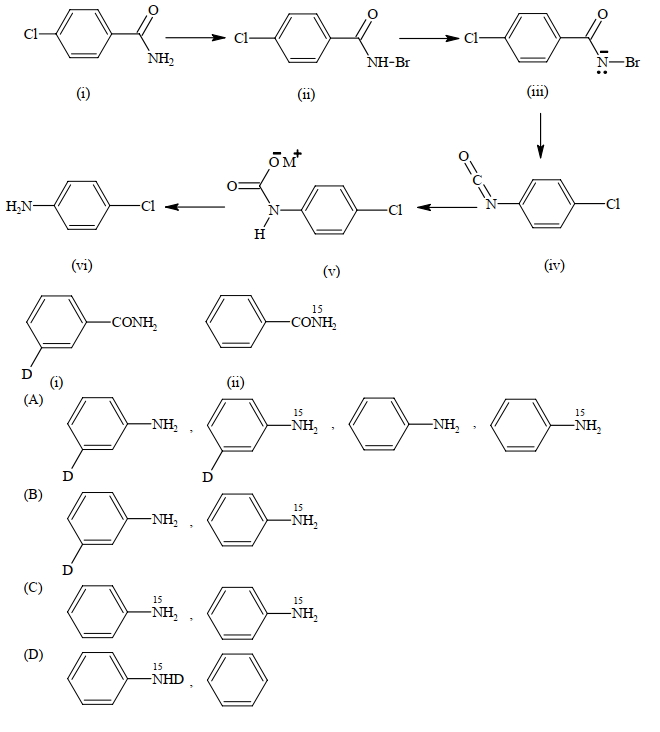
$\mathrm{RCONH}_2$ is converted into $\mathrm{RNH}_2$ by means of Hofmann bromamide degradation.

$Image$

In this reaction, $\mathrm{RCONHBr}$ is formed from which this reaction has derived its name. Electron donating group at phenyl activates the reaction. Hofmann degradation reaction is an intramolecular reaction.

$1.$  How can the conversion of $(i)$ to $(ii)$ be brought about?

$(A)$ $\mathrm{KBr}$  $(B)$ $\mathrm{KBr}+\mathrm{CH}_3 \mathrm{ONa}$  $(C)$ $\mathrm{KBr}+\mathrm{KOH}$  $(D)$ $\mathrm{Br}_2+\mathrm{KOH}$

$2.$  Which is the rate determining step in Hofmann bromamide degradation?

$(A)$ Formation of $(i)$  $(B)$ Formation of $(ii)$  $(C)$ Formation of $(iii)$  $(D)$ Formation of $(iv)$

$3.$  What are the constituent amines formed when the mixture of $(i)$ and $(ii)$ undergoes Hofmann bromamide degradation?

$Image$

give the answer question $1$, $2$, and $3.$
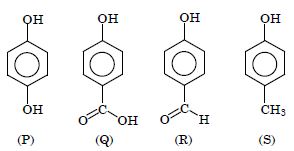
Decide decreasing order of acidic nature of above compound $P$ , $Q$ , $R$ & $S$
