MCQ
Which of the following complex ions will have maximum paramagnetic property?
  • A
    $\left[ Cr \left( H _2 O \right)_6\right]^{3+}$
  • B
    $\left[ Fe ( CN )_6\right]^4$
  • $\left[ Fe \left( H _2 O \right)_6\right]^{2+}$
  • D
    $\left[ Zn \left( H _2 O \right)_6\right]^{2+}$
Answer

Correct option: C.
$\left[ Fe \left( H _2 O \right)_6\right]^{2+}$
c

Need a full question paper?

Generate a complete, print-ready paper with questions like this in minutes — across 16+ boards, with answer keys.

Start Generating Free

Similar questions

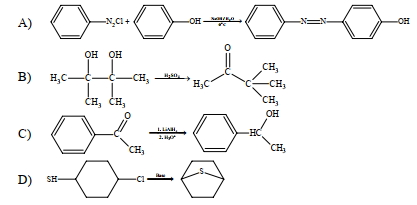
Match the reactions in Column $I$ with appropriate options in Column $II$.
Column $I$ Column $II$
$(A)$ $Image$ $(p)$ Racemic mixture
$(B)$ $Image$ $(q)$ Addition reaction
$(C)$ $Image$ $(r)$ Substitution reaction
$(D)$ $Image$ $(s)$ Coupling reaction
  $(t)$ Carbocation intermediate

When sucrose is heated with conc. $HN{O_3}$ the product is
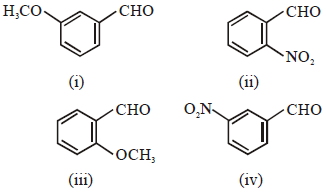
The increasing order of the following compounds towards $HCN$ addition is 
Which characteristics the weak inter molecular forces of attraction in a liquid?
The amount of ${K_2}C{r_2}{O_7}$ (eq. wt. $ 49.04$) required to prepare $100\,ml$ of its $0.05\,N$  solution is ........ $g$
$t_{1/2} =$ constant, confirms the first order reaction, If $a^2t_{1/2} =$ constant, confirms that the order of reaction is ($a =$ initial concentration of reactant)
A mixture of ethyl alcohol and propyl alcohol has a vapour pressure of $290 \,mm$ at $300\, K.$ The vapour pressure of propyl alcohol is $200\, mm.$ If the mole fraction of ethyl alcohol is $0.6,$ its vapour pressure ( in $mm$) at the same temperature will be
For the electro chemical cell

$\mathrm{M}\left|\mathrm{M}^{2+}\right||\mathrm{X}| \mathrm{X}^{2-}$

If $\mathrm{E}_{\left(\mathrm{M}^{2+} / \mathrm{M}\right)}^0=0.46 \mathrm{~V}$ and $\mathrm{E}_{\left(\mathrm{x} / \mathrm{X}^{2-}\right)}^0=0.34 \mathrm{~V}$.

Which of the following is correct?

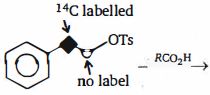
product; Product of this reaction is
$\begin{matrix}
   C{{H}_{2}}-C{{H}_{2}}-C{{O}_{2}}H\xrightarrow[BaC{{O}_{3}}]{\Delta }A\xrightarrow{N{{H}_{2}}-N{{H}_{2}}}B\xrightarrow[KOH]{heat}(C),  \\
   |\,\,\,\,\,\,\,\,\,\,\,\,\,\,\,\,\,\,\,\,\,\,\,\,\,\,\,\,\,\,\,\,\,\,\,\,\,\,\,\,\,\,\,\,\,\,\,\,\,\,\,\,\,\,\,\,\,\,\,\,\,\,\,\,\,\,\,\,\,\,\,\,\,\,\,\,\,\,\,\,\,\,\,\,\,\,\,\,\,\,\,\,\,\,\,\,\,\,\,\,\,\,\,\,\,\,\,\,\,\,\,\,\,\,\,\,\,\,\,\,\,\,\,\,\,\,\,\,\,\,\,\,  \\
   C{{H}_{2}}-C{{H}_{2}}-C{{O}_{2}}H\,\,\,\,\,\,\,\,\,\,\,\,\,\,\,\,\,\,\,\,\,\,\,\,\,\,\,\,\,\,\,\,\,\,\,\,\,\,\,\,\,\,\,\,\,\,\,\,\,\,\,\,\,\,\,\,\,\,\,\,\,\,\,\,\,\,\,\,\,\,\,\,\,\,\,\,\,\,\,\,\,  \\
\end{matrix}$

Product $(C)$ obtained is