MCQ
Which of the following complex is paramagnetic and inner orbital complex
- A$[Fe(CN)_6]^{4-}$
- ✓$[Cr(NH_3)_6]^{3+}$
- C$[Co(NH_3)_6]^{3+}$
- D$[Fe(NO_2)_6]^{4-}$
The electronic configuration of ${ }_{27} Co =1 s ^2, 2 s ^2, 2 p ^6, 3 s ^2 3 p ^6 3 d ^7, 4 s ^2$
$Co ^{3+}=1 s^2 2 s^2 2 p^6, 3 s^2 3 p^6 3 d^6$
Thus, $\left[ Co \left( NH _3\right)_6\right)^{3+}$ shows inner orbital complex as well as diamagnetic in behaviour (due to absence of an unpaired electron).
$\left[ Zn \left( NH _3\right)_6\right]^{2+} \rightarrow sp ^3 d ^2$ hybridisation (outer) and diamagnetic.
$\left[ Cr \left( NH _3\right)_6\right]^{3+} \rightarrow d ^2 sp ^3$ hybridisation (inner) and paramagnetic.
Generate a complete, print-ready paper with questions like this in minutes — across 16+ boards, with answer keys.
$(i)$ Glucose $+ ROH \quad \stackrel{\text { dry } HCl }{\longrightarrow}$ Acetal
$\xrightarrow[{{{\left( {C{H_3}CO} \right)}_2}O}]{{x\,eq.of}}$ acetyl derivative
$(ii)$ Glucose $\xrightarrow{{Ni/{H_2}}}A\xrightarrow[{{{\left( {C{H_3}CO} \right)}_2}O}]{{y\,\,eq.\,of}}$ acetyl derivative.
$(iii)$ Glucose $\xrightarrow[{{{\left( {C{H_3}CO} \right)}_2}O}]{{z\,ed.\,of}}$ acetyl derivative.
$' x ^{\prime},{ }^{\prime} y ^{\prime}$ and ${ }^{\prime} z^{\prime}$ in these reactions are respectively.
$2NO(g) + Cl_2(g) \to 2NOCl(g)$ at $298\, K$
$[Cl_2]$ $[NO]$ Rate $(mol\, L^{-1} \sec^{-1})$
$I$ $0.05\, M$ $0.05\,M$ $1 \times 10^{-3}$
$II$ $0.15\, M$ $0.05\,M$ $3 \times 10^{-3}$
$III$ $0.05\, M$ $0.15\,M$ $9 \times 10^{-3}$
The rate law for the reaction is
In the light of the above statements, choose the correct answer from the options given below :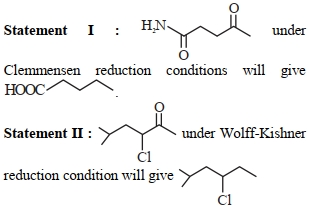
$H_3PO_4$ $\xrightarrow{{600\,{\,^o}C}}(Y)$
$(X)$ and $(Y)$ is