MCQ
Which of the following compoud will most readily dehydrated?
- A

- B
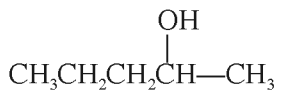
- ✓
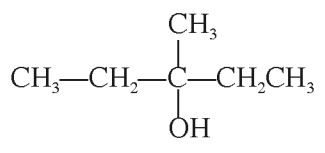
- D
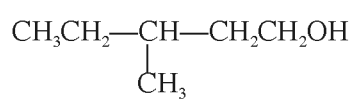
Generate a complete, print-ready paper with questions like this in minutes — across 16+ boards, with answer keys.
$ \mathrm{Ag}^{+}+\mathrm{e}^{-} \rightarrow \mathrm{Ag} ; \mathrm{E}_{\text {red }}^{\circ}=0.8 \mathrm{~V} $
$ \mathrm{C}_6 \mathrm{H}_{12} \mathrm{O}_6+\mathrm{H}_2 \mathrm{O} \rightarrow \text { Gluconic acid }\left(\mathrm{C}_6 \mathrm{H}_{12} \mathrm{O}_7\right)+2 \mathrm{H}^{+}+2 \mathrm{e}^{-} ; \mathrm{E}_{\text {oxd }}^{\circ}=-0.05 \mathrm{~V} $
$ \mathrm{Ag}\left(\mathrm{NH}_3\right)_2^{+}+\mathrm{e}^{-} \rightarrow \mathrm{Ag}(\mathrm{s})+2 \mathrm{NH}_3 ; \mathrm{E}_{\text {red }}^{\circ}=0.337 \mathrm{~V}$
[Use $2.303 \times \frac{\mathrm{RT}}{\mathrm{F}}=0.0592$ and $\frac{\mathrm{F}}{\mathrm{RT}}=38.92$ at $298 \mathrm{~K}$ ]
$1.$ $2 \mathrm{Ag}^{+}+\mathrm{C}_6 \mathrm{H}_{12} \mathrm{O}_6+\mathrm{H}_2 \mathrm{O} \rightarrow 2 \mathrm{Ag}(\mathrm{s})+\mathrm{C}_6 \mathrm{H}_{12} \mathrm{O}_7+2 \mathrm{H}^{+}$
Find $\ln \mathrm{K}$ of this reaction.
$(A)$ $66.13$ $(B)$ $58.38$ $(C)$ $28.30$ $(D)$ $46.29$
$2.$ When ammonia is added to the solution, $\mathrm{pH}$ is raised to $11$ . Which half-cell reaction is affected by $\mathrm{pH}$ and by how much?
(A) $E_{\text {oxd }}$ will increase by a factor of $0.65$ from $E_{\text {oxd }}^{\circ}$
(B) $E_{\text {oxd }}$ will decrease by a factor of $0.65$ from $E_{\mathrm{cod}}^{\prime}$
(C) $\mathrm{E}_{\text {red }}$ will increase by a factor of $0.65$ from $\mathrm{E}_{\text {rod }}^{\circ}$
(D) $E_{\text {red }}$ will decrease by a factor of $0.65$ from $E_{\text {rod }}^2$
$3.$ Ammonia is always is added in this reaction. Which of the following must be incorrect?
$(A)$ $\mathrm{NH}_3$ combines with $\mathrm{Ag}^{+}$to form a complex.
$(B)$ $\mathrm{Ag}\left(\mathrm{NH}_3\right)_2^{+}$is a stronger oxidising reagent than $\mathrm{Ag}^{+}$.
$(C)$ In absence of $\mathrm{NH}_3$ silver salt of gluconic acid is formed.
$(D)$ $\mathrm{NH}_3$ has affected the standard reduction potential of glucose/gluconic acid electrode.
Give the answer question $1,2$ and $3.$
$6 OH ^{-}+ Cl ^{-} \rightarrow ClO _{3}^{-}+3 H _{2} O +6 e ^{-}$
If only $60 \%$ of the current is utilized in the reaction, the time (rounded to the nearest hour) required to produce $10\, g$ of $KCIO _{3}$ using a current of $2\, A$ is..........
(Given : $F =96,500\, C\, mol ^{-1}$ molar mass of $\left. KClO _{3}=122\,gmol ^{-1}\right)$
