MCQ
Which of the following compound has electrovalent linkage
  • A
    $C{H_3}Cl$
  • $NaCl$
  • C
    $C{H_4}$
  • D
    $C{l_2}$

Answer

Correct option: B.
$NaCl$
(b) $Na$ is highly electropositive while $Cl$ is highly electronegative so they will form ionic bond.

Need a full question paper?

Generate a complete, print-ready paper with questions like this in minutes — across 16+ boards, with answer keys.

Start Generating Free

Similar questions

In which of the molecule $\pi-$ electrons are not delocalized ?
Red lead in an example of a/an .... oxide
A $50\, watt$ bulb emits monochromatic red light of wavelength of $795\, \mathrm{~nm}$. The number of photons emitted per second by the bulb is $\mathrm{x} \times 10^{20}$. The value of $\mathrm{x}$ is ...... .

$\left[\right.$ Given $: \mathrm{h}=6.63 \times 10^{-34} \,\mathrm{Js}$ and $\left.\mathrm{c}=3.0 \times 10^{8} \,\mathrm{~ms}^{-1}\right]$

A reversible chemical reaction having two reactants in equilibrium. If the concentrations of the reactants are doubled, then the equilibrium constant will
For the reaction $2 \mathrm{NO}_{2}(\mathrm{~g}) \rightleftharpoons \mathrm{N}_{2} \mathrm{O}_{4}(\mathrm{~g})$, when $\Delta \mathrm{S}=-176.0\, \mathrm{JK}^{-1}$ and $\Delta \mathrm{H}=-57.8\, \mathrm{~kJ}\, \mathrm{~mol}^{-1}$, the magnitude of $\Delta \mathrm{G}$ at $298\, \mathrm{~K}$ for the reaction is $......\,\mathrm{kJ} \mathrm{mol}^{-1} .$ (Nearest integer)
Addition of $BH_3$ followed by $H_2O_2$ to trans- $2$ -butene would give a  product which is
The energies $E_1$ and $E_2$ of two radiations are $25\ eV$ and $50\ eV$ respectively. The relation between their wavelengths i.e., $\lambda _1$ and $\lambda _2$ will be
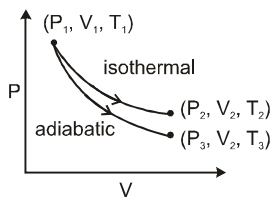
The reversible expansion of an ideal gas under adiabatic and isothermal conditions is shown in the figure. Which of the following statement$(s)$ is (are) correct? $Image$ 

$(A)$ $T _1= T _2$ $(B)$ $T _3> T _1$

$(C)$ $W _{\text {isothermal }} > W _{\text {adiabatic }}$ $(D)$ $\Delta U_{\text {isothermal }}>\Delta U_{\text {adiabatic }}$
Find odd compound out :
The five $P-F$ bond lengths in $PF_5$ are equal whereas the $P-Cl$ bond lengths in $PCl_5$ are not equal because