MCQ
Which of the following compound is diamagnetic
  • A
    $K_4[Fe^{+2}(CN)_5(O_2 )]$
  • $[NiF_6]^{-2}$
  • C
    $[Fe(H_2O)_5(NO)]^{+2}$
  • D
    All of these

Answer

Correct option: B.
$[NiF_6]^{-2}$
b
$K_4[Fe^{+2}(CN)_5(O_2)]$ is paramagnetic due to $O_2^\circleddash$

$[NiF_6]^{2-} \to d^2sp^3$ hybridisation, diamagnetic

$[Fe(H_2O)_5(NO)]^{+2} \to $ paramagnetic

Need a full question paper?

Generate a complete, print-ready paper with questions like this in minutes — across 16+ boards, with answer keys.

Start Generating Free

Similar questions

(image) $\xrightarrow{{B{r_2}/hv}}$ $\mathop {Major}\limits_{\left( X \right)} \xrightarrow[{KOH/\Delta }]{{Alcoholic}}\mathop {Major}\limits_{\left( Y \right)} $$\xrightarrow[{Peroxide}]{{H - Br}}\mathop {Major}\limits_{\left( Z \right)} $

Major final product $(Z)$ is

$S{O_2}$ is obtained when
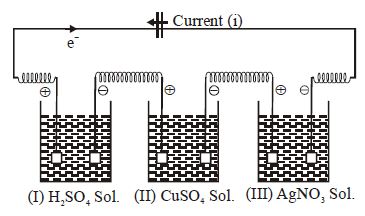
Three voltameters containing and aqueous solution of $H_2SO_4,$ $CuSO_4$ and $AgNO_3$ are connected in the following way

A current was passed for $10$ hours. $10.8\ g Ag$ was deposited at cathode in $(III)$ electrolytic cell during electrolysis if current efficiency is $50\%.$

If $Z_1,$ $Z_2$ and $Z_3$ be the electrochemical equivalent in the formation of $H_2, Cu$ and $Ag$ respectively, hence $Z_1 : Z_2 : Z_3$ would be
Which of the following is correct statement for the given reaction

$C{H_3} - CH = O + {C_6}{H_5} - CH =O \xrightarrow[\Delta ]{{\mathop O\limits^\Theta  H\,\left( {aq} \right)}}\mathop X\limits_{{\text{(}}{{\text{C}}_4}{{\text{H}}_6}{\text{O)}}}  + \mathop Y\limits_{{\text{(}}{{\text{C}}_9}{{\text{H}}_8}{\text{O)}}} $

$Y$ is
In Haber's process for the manufacture of ammonia, the catalyst used is:
The one that can exhibit highest paramagnetic behaviour among the following is :-

gly $=$ glycinato; bpy $=2,2$ '-bipyridine

$Cu^{2+} + 2e^-\to Cu$. On increasing $[Cu^{2+}]$ concentration, electrode potential
During an electrolysis of conc. $H_2SO_4$ , perdisulphuric acid $(H_2S_2O_8)$ and $O_2$ form in equimolar amount. The amount of $H_2$ that will form simultaneously will be $(2{H_2}S{O_4} \to {H_2}{S_2}{O_8} + 2{H^ + } + 2{e^ - })$
Select the compound in which $HCl$ is not the product of Hydrolysis