MCQ
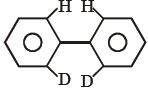
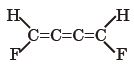
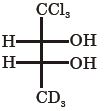
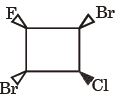
Which of the following compound is optically active?
  • A

  • B


  • D

Answer

Correct option: C.

c
Compound having no $POS$, no $COS$ are optically active.

Need a full question paper?

Generate a complete, print-ready paper with questions like this in minutes — across 16+ boards, with answer keys.

Start Generating Free

Similar questions

Which of the following species is not paramagnetic ?
Arrange the following amines in the order of increasing basicity.
Number of complexes from the following with even number of unpaired "$d$" electrons is  . . . . . . . . . .

${\left[\mathrm{V}\left(\mathrm{H}_2 \mathrm{O}\right)_6\right]^{3+}, \quad\left[\mathrm{Cr}\left(\mathrm{H}_2 \mathrm{O}\right)_6\right]^{2+}, \quad\left[\mathrm{Fe}\left(\mathrm{H}_2 \mathrm{O}\right)_6\right]^{3+},}$

${\left[\mathrm{Ni}\left(\mathrm{H}_2 \mathrm{O}\right)_6\right]^{3+},\left[\mathrm{Cu}\left(\mathrm{H}_2 \mathrm{O}\right)_6\right]^{2+}}$

[Given atomic numbers: $\mathrm{V}=23, \mathrm{Cr}=24, \mathrm{Fe}=26$,

$\mathrm{Ni}=28, \mathrm{Cu}=29]$

In the reaction sequence $2C{H_3}CHO\xrightarrow{{O{H^ - }}}A\xrightarrow{\Delta }B$ ; the product $B$ is
Oxygen in absorbed by molten $Ag$, which is evolved on cooling and the silver particles are scattered, this phenomenon is known as
Which of the following diagram show correct change in the ionic character of given compounds according to Fajans rule ?
Visible light will be absorbed by
The major product of the following reaction is

$\begin{array}{*{20}{c}}
  {OH\,\,\,\,\,\,\,\,\,\,\,\,\,\,\,\,\,\,\,\,\,\,} \\ 
  {|\,\,\,\,\,\,\,\,\,\,\,\,\,\,\,\,\,\,\,\,\,\,\,\,\,\,\,} \\ 
  {C{H_3}CHC{H_2}C{H_2}N{H_2}} 
\end{array}$ $\xrightarrow[{triethyla\min e}]{{ethyl\,formate\,\left( {1\,equiv} \right)}}$

The solubility product of $A{s_2}{S_3}$ is $2.8 \times {10^{ - 72}}$. What is the solubility of $A{s_2}{S_3}$
The ratio of the mass percentages of $'C$ $\&$ $H'$ and $'C$ $\&$ $O'$ of a saturated acyclic organic compound$'X'$ are $4 : 1$ and $3 : 4$ respectively. Then, the moles of oxygen gas required for complete combustion of two moles of organic compound $'X$' is