MCQ
Which of the following compound is wrongly named ?
  • A
    $\begin{array}{*{20}{c}}
      {C{H_3}C{H_2}C{H_2}CHCOOH} \\ 
      {\,\,\,\,\,\,\,|} \\ 
      {\,\,\,\,\,\,\,\,Cl} 
    \end{array}$ $\rightarrow$ $2-$Chloro pentanoic acid
  • $\begin{array}{*{20}{c}}
      {C{H_3}C \equiv CCHCOOH} \\ 
      {\,\,\,|} \\ 
      {\,\,\,\,\,\,C{H_3}} 
    \end{array}$  $\rightarrow$  $2-$ Methyl hex$-3-$enoic acid
  • C
    $CH_3CH_2CH=CHCOCH_3$  $\rightarrow$ Hex$-3-$en$-2-$one
  • D
    $\begin{array}{*{20}{c}}
      {C{H_3} - CHC{H_2}C{H_2}CHO} \\ 
      {|\,\,\,\,\,\,\,\,\,\,\,\,\,\,\,\,\,\,\,\,} \\ 
      {C{H_3}\,\,\,\,\,\,\,\,\,\,\,\,\,\,} 
    \end{array}$ $\rightarrow$ $4-$Methyl pentanal
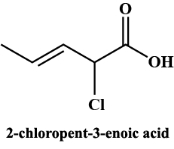
Answer

Correct option: B.
$\begin{array}{*{20}{c}}
  {C{H_3}C \equiv CCHCOOH} \\ 
  {\,\,\,|} \\ 
  {\,\,\,\,\,\,C{H_3}} 
\end{array}$  $\rightarrow$  $2-$ Methyl hex$-3-$enoic acid
b
The correct IUPAC name of compound in option B is $2$-chloropent-$3$-enoic acid.

The parent compound is pentanoic acid. A double bond is present between third and fourth carbon atoms.

Chlorine group is present at second carbon atom.

Need a full question paper?

Generate a complete, print-ready paper with questions like this in minutes — across 16+ boards, with answer keys.

Start Generating Free

Similar questions

Compare the stabilities of the following two compounds :
$A$ : cis- $1$ -Ethyl- $3$ -methylcyclohexane
$B$ : trans- $1$ -Ethyl- $3$ -methylcyclohexane
Radius of the nucleus is equal to $10^{-12}\, cm.$ and that of the atom is equal to $10^{-8} \,cm.$ What is the fraction of the volume of the atom occupied by nucleus ?
$STATEMENT-1$: $\quad \mathrm{Pb}^{4+}$ compounds are stronger oxidizing agents than $\mathrm{Sn}^{4+}$ compounds.and

$STATEMENT-2$: The higher oxidation states for the group $14$ elements are more stable for the heavier members of the group due to 'inert pair effect'.

Pyrosilicate ion is
Which of the following is technique used to measure the heat of a reaction?
Work done during isothermal expansion of one mole of $1$ mole of an ideal gas from $10$ $atm$ to $1$ atm at $300 \,K$  is.......$cal$ (Gas constant $= 2$ )
Assuming complete dissociation, the $pH$ of a $0.01 \,M$  $NaOH$ solution is equal to
Tin is obtained from cassiterite by reduction with coke. Use the data given below to determine the minimum temperature (in $K$ ) at which the reduction of cassiterite by coke would take place.

At $ 298 K : \Delta_{ f } H ^{\circ}\left( SnO _2( s )\right)=-581.0 kJ mol ^{-1}, \Delta_{ fH } H ^{\circ}\left( CO _2( g )\right)=-394.0 kJ mol ^{-1}$

$S ^{\circ}\left( SnO _2( s )\right)=56.0 J K ^{-1} mol ^{-1}, S ^{\circ}( Sn ( s ))=52.0 J K ^{-1} mol ^{-1}$

$S ^{\circ}( C ( s ))=6.0 J K ^{-1} mol ^{-1}, S ^{\circ}\left( CO _2( g )\right)=210.0 J K ^{-1} mol ^{-1}$

Assume that the enthalpies and the entropies are temperature independent.

Find the concentration of ion which is first precipitated at the point when the third ion starts precipitating, if $AgNO_3$ is added gradually to the solution that contains $0 .1\ M\  Cl^-, 0 .1\  M\ Br^-$ and $0. 1\ M\ I^-$

Given that

Salt            ||         $K_{sp}$

$AgCl$        ||        $2 \times {10^{ - 10}}$

$AgBr$       ||       $5 \times {10^{ - 13}}$

$Ag$           ||        $9 \times {10^{ - 17}}$

The liquid field metal expanding on solidification is