MCQ
Which of the following compounds are optically active
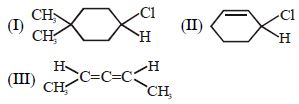
  • A
    $(I)$ and $(III)$
  • B
    $(I)$ and $(II)$
  • $(II)$ and $(III)$
  • D
    $(I), (II)$ and $(III)$

Answer

Correct option: C.
$(II)$ and $(III)$
c

Need a full question paper?

Generate a complete, print-ready paper with questions like this in minutes — across 16+ boards, with answer keys.

Start Generating Free

Similar questions

The total number of unpaired electrons in $d$- orbitals of atoms of element of atomic number $29$ is
For a given exothermic reaction, $K_p$ and $K'_p$  are the equilibrium constants at temperatures $T_1$ and $T_2,$ respectively. Assuming that heat of reaction is constant in temperature range between $T_1$ and $T_2,$ it is readily observed that
For a dimerization reaction,

$2 A ( g ) \rightarrow A _{2}( g )$

at $298\, K , \Delta U^ \ominus,=-20\, kJ\, mol ^{-1}, \Delta S \odot=-30\, J$$K ^{-1}\, mol ^{-1},$ then the $\Delta G ^{\ominus}$ will be........$J$

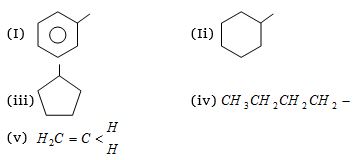
Decreasing order of rate of electrophilic aromatic substitution is
The following equilibrium exists in aqueous solution $C{H_3}COOH$ $\rightleftharpoons$ $C{H_3}CO{O^ - } + {H^ + }$. If dilute $HCl$ is added without a change in temperature, then the
Calculate maximum possible heat which can be released if a $4\ l$ aqueous solution is to be formed by mixing appropriate yolumes of $2\ M\  NaOH$ and $3\ M\  H_2SO_4$ solution $\Delta {H_{{\text{neutralisation}}\,\,{\text{SA/SB}}}} =  - 14\ kcal/mol$ ......$ kcal$
In molecules of the type $AX_2L_n$ (where $L$ represents lone pairs and $n$ is  its number) there exists a bond between element $A$ and $X.$ The $\angle X A X$  bond angle
Ionisation enthalpy $(\triangle _i \ H_1\  kJ\  mol^{-1})$ for the elements of Group $13$ follows the order.
Which of the following is the strongest $o,p-$ directing group?
Examine the following common chemical structures to which simple functional groups are often attached Which of these systems have essentially planar geometry