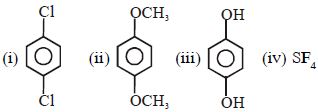
MCQ
Which of the following cyclopentane derivative is optically inactive ?
- A
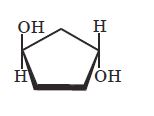
- B
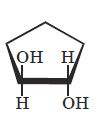
- ✓
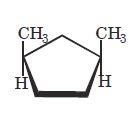
- D
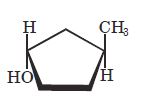
So the correct option is $C$.
Generate a complete, print-ready paper with questions like this in minutes — across 16+ boards, with answer keys.
$Ca_3(PO_4)_2 + SiO_2 + C + O_2 + H_2O \to CaSiO_3 + CO_2 + H_3PO_4$
If $1.0\ kg$ each of calcium phosphate and silica are used with excess of $C$ , $O_2$ and $H_2O$ , what is maximum quantity of phosphoric acid that can be produced. $(Ca = 40, P = 31, Si = 28)$
$C{H_3} - \mathop {\mathop {\mathop {\mathop C\limits^| }\limits^{Cl} - }\limits_{|\,\,\,\,} }\limits_{OH} C{H_2}CH = CHC{H_3}$
$\begin{array}{*{20}{c}}
{\,\,\,\,\,\,\,\,O\,\,\,\,\,\,\,\,\,\,\,\,\,\,\,\,\,\,\,\,\,\,\,C{H_3}\,} \\
{\,\,\,\,||\,\,\,\,\,\,\,\,\,\,\,\,\,\,\,\,\,\,\,\,\,\,\,\,\,|\,\,} \\
{C{H_3} - C - C{H_2} - C - CN} \\
{\,\,\,\,\,\,\,\,\,\,\,\,\,\,\,\,\,\,\,\,\,\,\,\,\,\,\,\,\,|\,} \\
{\,\,\,\,\,\,\,\,\,\,\,\,\,\,\,\,\,\,\,\,\,\,\,\,\,\,\,\,\,\,\,\,\,\,C{H_3}}
\end{array}$