MCQ
Which of the following does not have optical isomer
  • $[Co{(N{H_3})_3}C{l_3}]$
  • B
    $[Co{(en)_3}]C{l_3}$
  • C
    $[Co{(en)_2}C{l_2}]Cl$
  • D
    $[Co(en){(N{H_3})_2}C{l_2}]Cl$

Answer

Correct option: A.
$[Co{(N{H_3})_3}C{l_3}]$
a
(a)$[Co{(N{H_3})_3}C{l_3}]$ does not have optical isomers because it is of formula $M{A_3}{B_3}$ which does not show optical isomerism.

Need a full question paper?

Generate a complete, print-ready paper with questions like this in minutes — across 16+ boards, with answer keys.
Start Generating Free

Similar questions

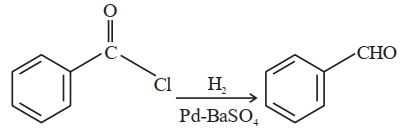
$Image$ The reduction reaction known as:
If $Ni ^{2+}$ is replaced by $Pt ^{2+}$ in the complex $\left[ NiCl _2 Br _2\right]^{2-}$, which of the following properties are expected to get changed?

$A.$ Geometry

$B.$ Geometrical isomerism

$C.$ Optical isomerism

$D.$ Magnetic properties

Given below are two statements:

Statement - $I$: High concentration of strong nucleophilic reagent with secondary alkyl halides which do not have bulky substituents will follow $\mathrm{S}_{\mathrm{N}} 2$ mechanism.

Statement - $II$: A secondary alkyl halide when treated with a large excess of ethanol follows $\mathrm{S}_{\mathrm{N}} 1$ mechanism.

In the the light of the above statements, choose the most appropriate from the questions given below:
When $KMn{O_4}$ is reduced with oxalic acid in acidic solution, the oxidation number of $Mn$ changes from
On hydrolysis of a "compound", two compounds are obtained. One of which on treatment with sodium nitrite and hydrochloric acid gives a product which does not respond to iodoform test. The second one reduces Tollens reagent and Fehling's solution. The "compound" is
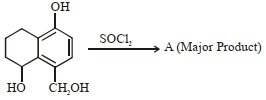
Identify $A$ in the given reaction.
The proteins with a prosthetic group are called
Compound obtained by the hydrolysis of Akyl cyanide is :
$Cu(s)|\,C{u^{ + 2}}(aq,{10^{ - 3}})\,|\,|\,A{g^ + }\,({10^{ - 5}}M)|\,Ag(s)$

if $E_{C{u^{ + 2}}/Cu}^o\, = \, + 0.34\,V$

$E_{A{g^ + }/Ag}^o\, = \, + 0.80\,V$

$E_{cell}$ will be

Which of the following pair of transitional elements exhibit highest and lowest density