MCQ
Which of the following does not reduce fehling's solution ?
  • A
    Glucose
  • B
    Benzaldehyde
  • C
    Sucrose
  • Both $(B)$ and $(C)$

Answer

Correct option: D.
Both $(B)$ and $(C)$
d

Need a full question paper?

Generate a complete, print-ready paper with questions like this in minutes — across 16+ boards, with answer keys.
Start Generating Free

Similar questions

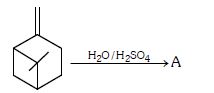
Identify $'A'$ in the reaction
Select equations having endothermic step

$(A)\,S_{\left( g \right)}^ - \,\, \to \,\,S_{\left( g \right)}^{2 - }\,$

$(B)\,Na_{\left( g \right)}^ + \, + \,Cl_{\left( g \right)}^ - \,\, \to \,\,NaCl\,(s)$

$(C)\,{N_{\left( g \right)}}\, \to \,\,N_{\left( g \right)}^ - $

$(D)\,Al_{\left( g \right)}^{2 + }\, \to \,\,Al_{\left( g \right)}^{3 + }$

Which is the correct relationship between wavelength and momentum of particles
Consider the following conversions :
$(i)\, O_{(g)} + e^- \to O_{(g)}^- , \Delta H_1$

$(ii)\, F_{(g)} + e^- \to F^-_{(g)}, \Delta H_2$

$(iii)\, Cl_{(g)} + e^- \to Cl_{(g)}, \Delta H_3$

$(iv)\, O_{(g)}^- + e^- \to O_{(g)}^{2-} , \Delta H_4$
That according to given information the incorrect statement is
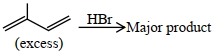
The major product formed in the following reaction is:
$1$ molal aqueous solution of an electrolyte $A _{2} B _{3}$ is $60 \%$ ionised. The boiling point of the solution at $1\, atm$ is ......... $K$.

(Rounded-off to the nearest integer)

[Given $K _{ b }$ for $\left.\left( H _{2} O \right)=0.52\, K\, kg\, mol ^{-1}\right]$

$N{a_2}{B_4}{O_7}.10{H_2}O \xrightarrow{\Delta } X + NaB{O_2} + {H_2}O$

$X + C{r_2}{O_3}\xrightarrow{\Delta }Y$ (Green coloured)

$X$ and $Y$ are

The major product formed when propene reacts with $HBr $ in presence of peroxides is
Molality of an aqueous solution of urea is $4.44 \mathrm{~m}$. Mole fraction of urea in solution is $x \times 10^{-5}$. Value of $x$ is. . . . . . (integer answer)
Compound $P$ is neutral. $Q$ gives effervescence with $NaHCO _3$ while $R$ reacts with Hinsbergs reagent to give solid soluble in $NaOH$. Compound $P$ is